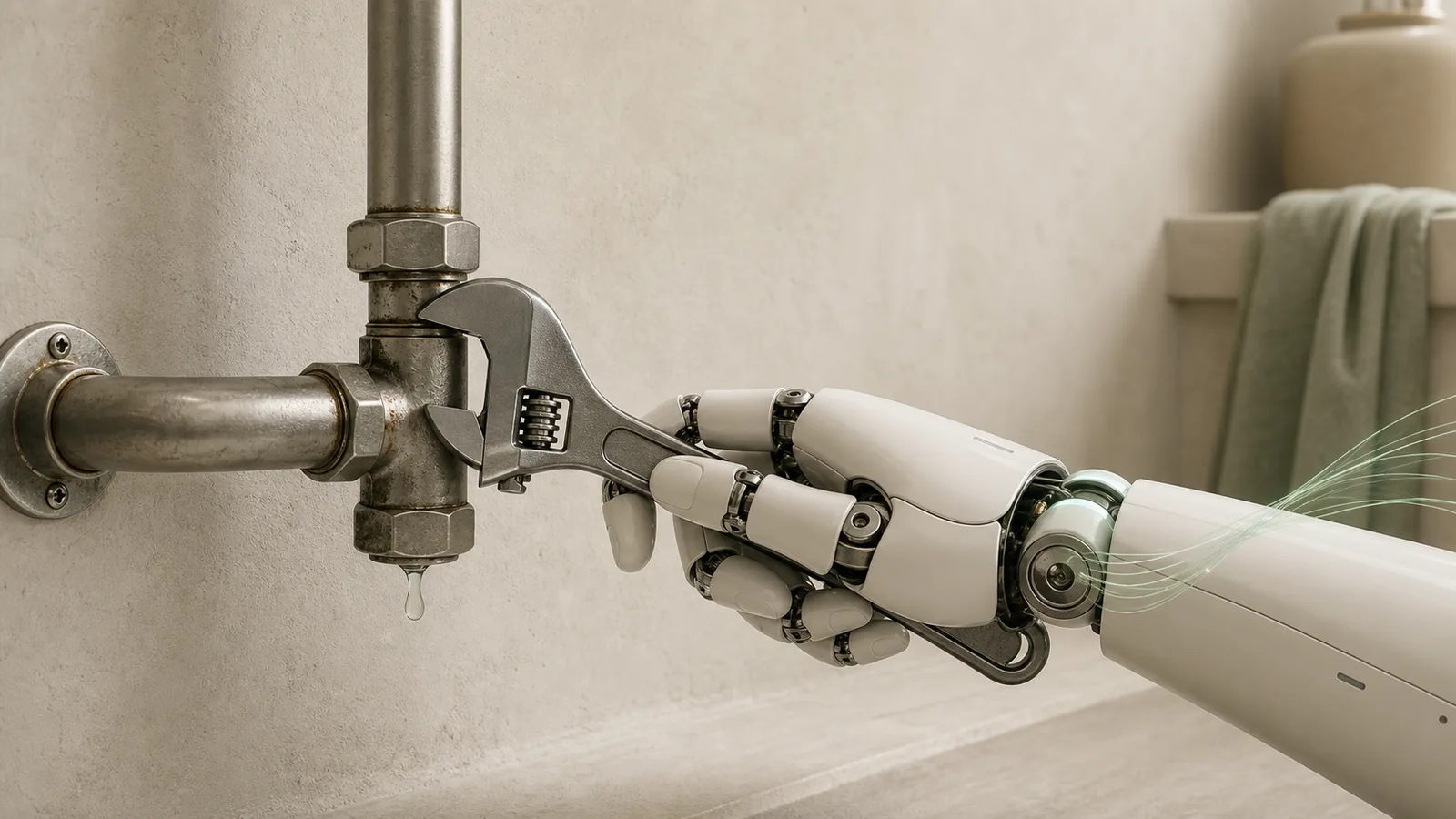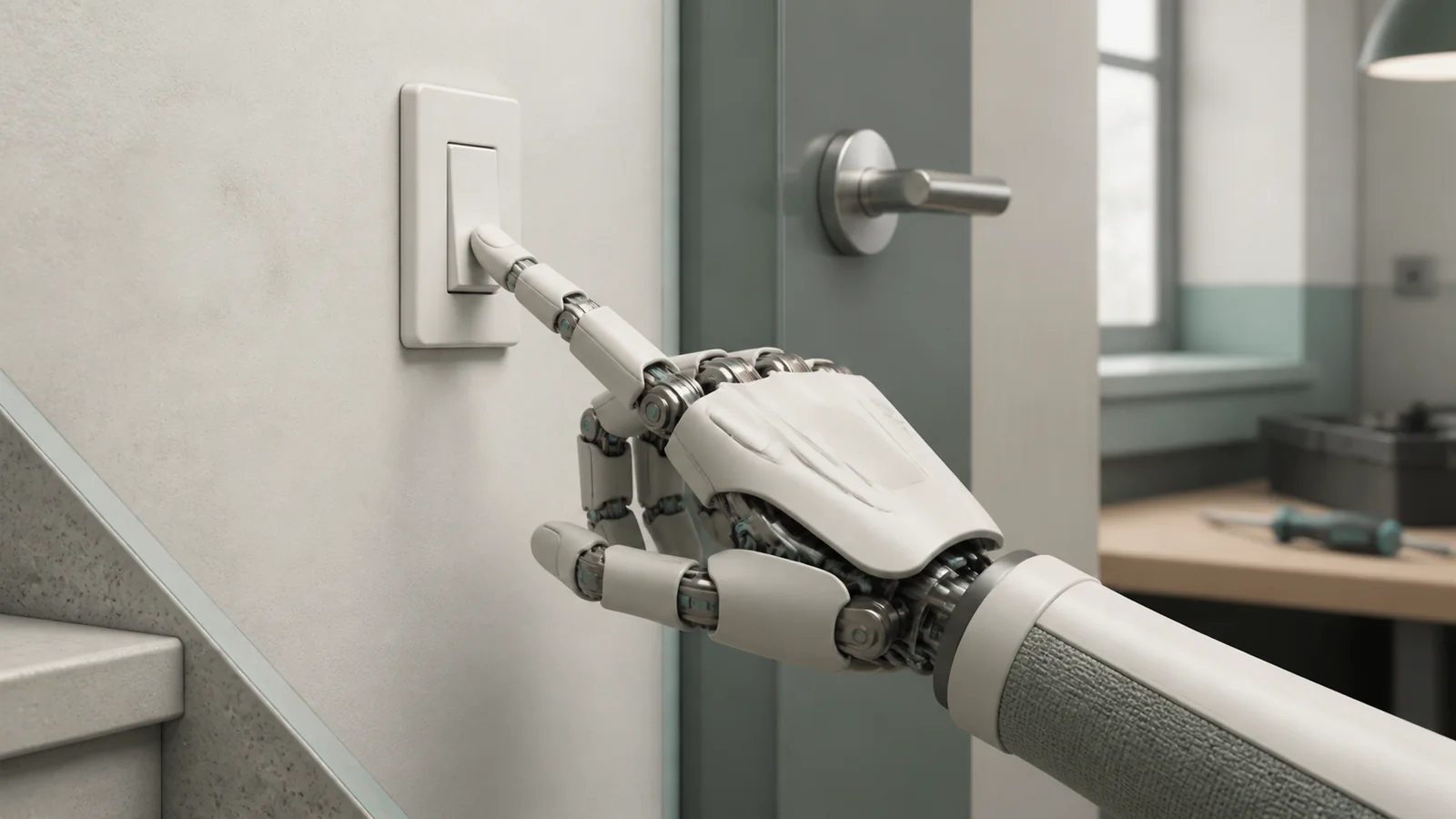
In July 2026, 1X unveiled new hands for NEO, its humanoid platform. On paper, they are a notable piece of engineering: 25 degrees of freedom—22 in the fingers and palm and three in the wrist—tendon-driven transmission, force control, and tactile sensors that measure pressure, contact location, and shear.
It is easy to focus on the demo: building with LEGO, turning a light bulb, opening a zip, or plugging in a USB-C cable. The more interesting point is not that a robotic hand increasingly resembles ours. It is the decision to build a machine that is compatible with an environment that was never designed for machines.
The physical world already has an interface
For centuries, we have built our surroundings around the human body. The height of a switch, the shape of a door handle, the spacing of stairs, the width of a corridor, and the grip of a tool all assume a certain height, two arms, opposable thumbs, and a particular way of moving.
In software, we would call that an interface. It is not documented in a technical contract, but it constrains everything the system can use. Our body is the client for which that interface was designed.
This is why humanoid morphology can make sense even when it is not the best mechanical solution for an isolated task. A robot with compatible dimensions and joints can open an existing door, climb a staircase, drive a vehicle, or use a tool without requiring the entire building to be redesigned first.
A recent perspective on robots in public transport identifies compatibility with human-designed environments as their central advantage. It also adds the important qualification: for structured, repetitive work, specialised machines remain cheaper, faster, and more robust.
Compatibility is not optimisation
If we can design the environment from scratch, copying the human body is often a poor decision.
Wheels are simpler and more efficient than two legs for moving goods across a regular floor. An industrial arm inside a controlled cell offers better precision and availability for welding the same joint thousands of times. A floor-cleaning robot does not need to be human-sized; it needs to fit under furniture.
The equation changes when three conditions coincide:
- the environment already exists and was built for people;
- tasks vary and cannot all be listed in advance;
- adapting the infrastructure costs more than adapting the machine.
That is where a general-purpose robot may create value. Human form does not optimise each action, but it reduces the integration cost across thousands of objects and spaces that are already deployed. It is a compatibility decision, not an exercise in imitation.
A hand is also a perception system
The specifications published by 1X help explain why hands are a bottleneck.
A simple gripper can execute a small vocabulary: pick, release, push. A hand with more joints expands that vocabulary, but movement alone is not enough. When handling a glass, a bag, or a piece of fruit, a robot needs to know how hard it is squeezing, where it is touching the object, and whether it is beginning to slip.
According to 1X, its transmission uses gear ratios of roughly 5:1 to 15:1 and makes the joints backdrivable: an external force can move them, and the system can measure that force in return. Tactile skin adds pressure and shear data. Together, these features turn the hand from a mere actuator into a perception channel.
Vision cannot solve every manipulation problem. An object may be occluded by the fingers, transparent, deformable, or already slipping before a camera detects it. Touch is not only a way to act on the world; it is a way to question it.
Hardware creates possibilities; it does not prove autonomy
Three layers are often mixed together in robotics videos:
- Mechanical capability: the hand can reach a pose, apply force, or detect contact.
- Task control: the system can coordinate movement to complete a specific action.
- Generalised autonomy: the robot can recognise a new situation, plan, recover from errors, and repeat the result reliably without human intervention.
The new hands provide evidence about the first layer and promising demonstrations of the second. They do not prove the third on their own. The published specifications and capability claims also come from the manufacturer; independent evidence on success rates, speed, maintenance, wear, and behaviour after thousands of cycles is still missing.
That distinction does not diminish a genuine hardware advance. It prevents a real improvement from being stretched into a much larger claim about autonomy that public evidence does not yet support.
What a real deployment should measure
A general-purpose robot should not be judged by how many different demos fit into a video, but by how it behaves when the environment stops cooperating. Useful questions include:
- What share of tasks does it complete without help, and how long do they take?
- How does it recover when an object moves or a door offers more resistance?
- How often does it require human intervention?
- How many cycles can tendons, coatings, and sensors withstand before maintenance?
- What happens around people, pets, liquids, and fragile objects?
- What does versatility cost compared with automating only the task we actually need?
The last question matters most. The more stable the task and the more control we have over the space, the less sense it makes to pay for humanoid form. The less predictable the environment and the broader the expected repertoire, the more valuable compatibility becomes.
The human form may not be the best way to build a machine. But it can be a reasonable way to build a machine that must use the world we have already built.