The other day I was talking to a friend who works as a designer and engineer. His forecast was fairly clear: AI will eventually do much of his work, but plumbers still have plenty of time.
The intuition seems reasonable. A model can already produce drawings, calculate alternatives, write documentation or generate code. No general-purpose robot can enter an unfamiliar home today, locate the source of a leak and repair it with the reliability of a professional.
But that comparison mixes two different questions. One is which jobs are most exposed to the current capabilities of AI. The other is how quickly the frontier of robotics can move when some of its software begins to benefit from the same advances.
The first clearly favours the plumber. The second makes it unwise to rely too heavily on a linear timeline.
The interesting question is not whether AI can describe how to replace a pipe. It is how much of the distance to a robot plumber depends on intelligence, and how much depends on hands, energy, reliability, safety and cost.
A job is not a single task
When we say that AI can replace a designer or cannot replace a plumber, we treat each occupation as an indivisible unit. In practice, both contain tasks with very different degrees of automation.
A designer may research requirements, propose alternatives, calculate, model, negotiate constraints, verify regulations and take responsibility for decisions. AI does not need to master the whole job to affect it. It only needs to reduce the time spent on some digital parts by a large margin.
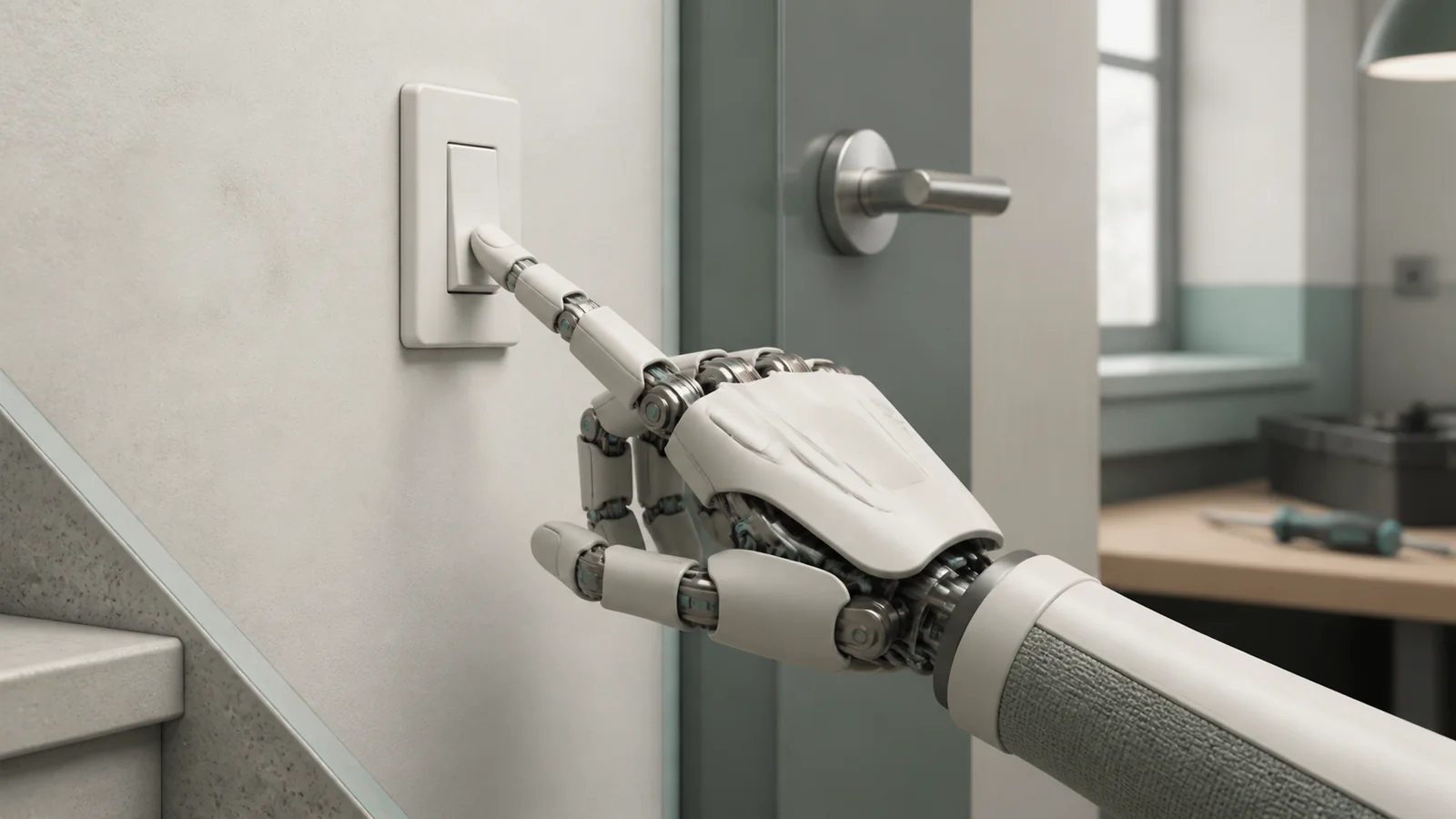
A plumber also diagnoses, plans, estimates materials, prepares quotes, documents work and communicates with the customer. Then they must travel, reach awkward places, cut, hold, seal, test pressure and respond to whatever is behind a wall. Some of that work is information. The rest requires intervening in a poorly controlled physical environment.
In 2025, the International Labour Organization estimated that one in four workers was in an occupation with some degree of exposure to generative AI. Clerical occupations were the most exposed, and exposure was also growing in highly digitised technical jobs. Its main conclusion, however, was not wholesale replacement but the transformation of tasks.
That distinction matters outside the office too. Automation usually enters an occupation in pieces, rather than taking over the entire role at once.
AI really is accelerating robotics
For decades, much of industrial automation has worked by reducing variability. The robot is fixed to the floor, the position of the parts is known, the machine is separated from people and a sequence is programmed to repeat thousands of times.
Recent models take a different approach. Vision-language-action models, known as VLAs, receive images and instructions and produce movements. They attempt to transfer what they have learnt between objects, tasks and, increasingly, different robot bodies.
That transfer can reduce several costs that previously had to be paid for every application:
- recognising objects and understanding new instructions;
- breaking an objective into intermediate actions;
- learning a task from demonstrations instead of programming every trajectory;
- reusing data collected by other robots;
- generating training variations through simulation and synthetic data;
- recovering from some changes without rebuilding the entire system.
The results already go beyond executing a familiar sequence. Physical Intelligence demonstrated π0.5 performing cleaning tasks lasting ten to fifteen minutes in homes that were absent from its training data. Google DeepMind says Gemini Robotics On-Device 2 can adapt to a new robot with fewer than 200 examples and a few hours of adaptation time.
These are research results published by their own developers, not product trials across thousands of homes. Even so, they point to an important change: improving a model can expand the repertoire of many machines without redesigning each one from scratch.
This is how progress in AI transfers to robotics. It does not invent a better battery or prevent wear in a mechanical tendon, but it reduces some of the work required for a robot body to perceive, plan and learn.
Not every bottleneck is software
A robot that can work outside an industrial cell must solve several layers at the same time.
The first is understanding the situation. It must recognise objects, estimate their position, interpret a request and decide on a sequence of actions. Multimodal models are pushing this layer forward quickly.
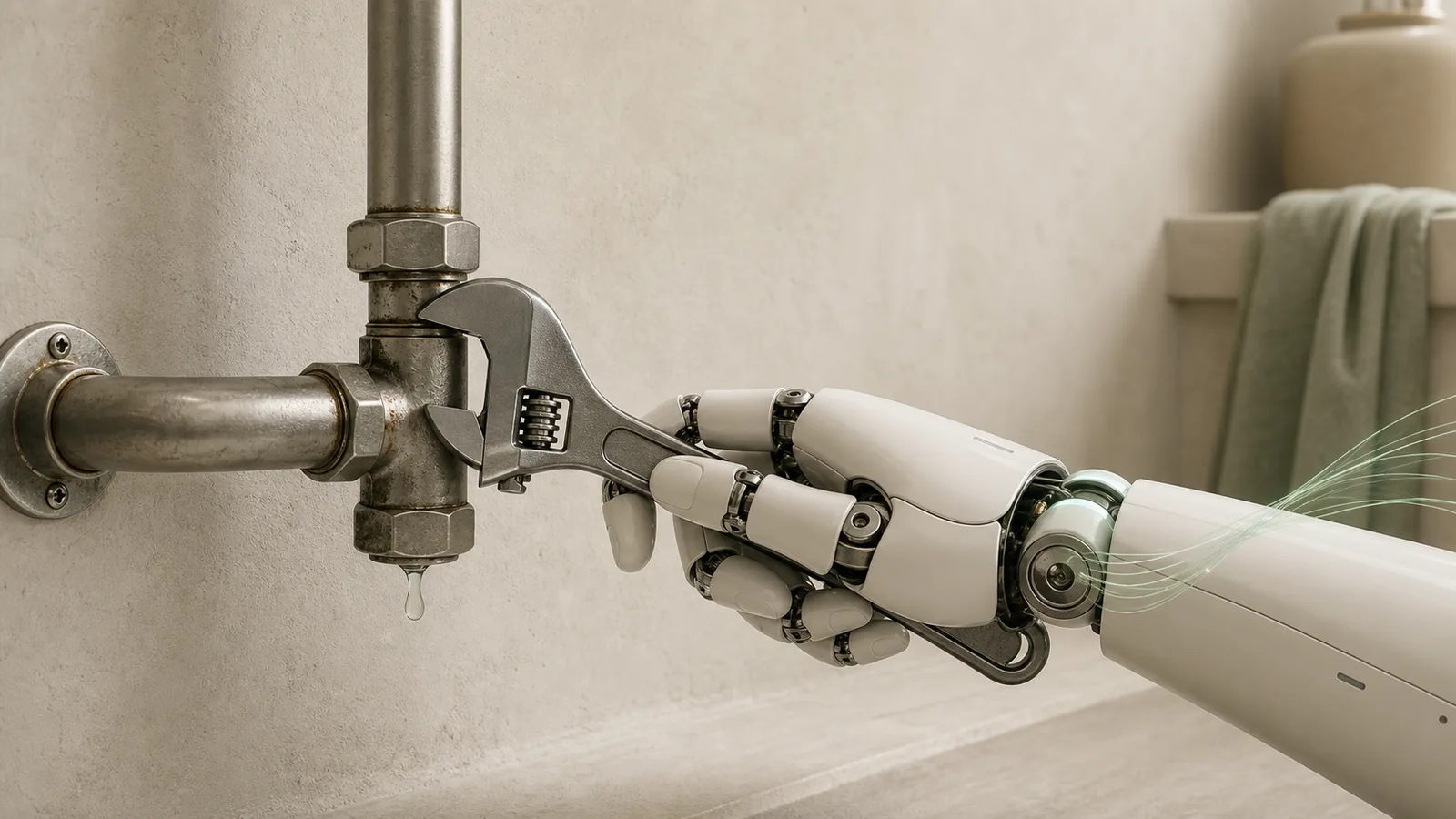
The second is controlling contact. Turning a wrench on a corroded joint is not simply a matter of reaching a set of coordinates. The robot must align the tool, apply force without deforming the part, sense whether it is slipping and change its movement according to the resistance. Vision helps, but it does not replace tactile sensing, force control or precise mechanics.
The third is having a body that can withstand the work. Actuators, gearboxes, cables, coverings and sensors must survive impacts, dust, water and thousands of cycles. The robot also needs sufficient payload and energy autonomy. A review of humanoids in construction published in Scientific Reports identifies batteries, payload, mechanical precision and resistance to adverse conditions among the barriers to deployment.
The fourth is completing the task reliably. A demonstration can select the best attempt. A professional service has to work on an ordinary Tuesday in a home that nobody prepared for the video.
Data published by Google DeepMind in July 2026 illustrates the distance. In its own tests, Gemini Robotics 2 achieved 92% when unscrewing a light bulb, but 36% when screwing one in, 44% when tying a rubbish bag and 40% when sealing a zip-lock bag with a five-fingered robotic hand. With a two-fingered gripper, it reached 89.6% on precise insertion tasks. These are genuine advances and, at the same time, results that are insufficient for an autonomous service.
Reliability becomes harder as a task grows longer. If an operation had twenty independent steps and each one worked 95% of the time, the probability of completing everything without a failure would be about 36%. The example simplifies the problem, but it shows why moving from an eye-catching skill to a full working day requires much more than gaining a few points on a test.
The final layer is making the system economically and legally viable. The cost of the machine is only the beginning. Transport, setup, supervision, maintenance, insurance and downtime all have to be added. Someone must also be accountable if the robot breaks a pipe, causes a flood or injures a person.
AI is accelerating the first layer substantially, is beginning to improve the second and helps test the others. It does not remove their material timescales.
A home is an especially difficult environment
Robots already work at scale, but mainly where the environment cooperates.
The International Federation of Robotics recorded almost 200,000 professional service robots sold in 2024 in its sample of 294 suppliers. More than half were for transport and logistics, primarily moving goods through indoor spaces without public traffic. The pattern is not accidental: level floors, known routes, standardised objects and repeatable operations reduce the number of surprises.
A domestic repair offers almost the opposite.
Every building combines different periods, materials and previous decisions. Pipes may be hidden. The workspace may be a cabinet, a suspended ceiling or a gap that barely fits a person. There are rigid parts, deformable seals, liquids, dirt and reflections that complicate perception. The same apparent fault can have different causes.
Diagnosis and repair also affect one another. Sometimes the problem remains unknown until a part is removed. Doing so may reveal corrosion, an installation that does not match the drawing or an incompatible replacement. The professional does not execute a closed plan: they investigate while modifying the environment.
Construction shares many of these difficulties. Spaces change every day, materials move, dust degrades sensors and several trades work at the same time. A factory can be adapted around a machine. An existing home is unlikely to be rebuilt to make an occasional robot visit easier.
That is why a plumber is not merely a manipulator with better hands. The role combines a diagnostic technician, a mobility system, a tool workshop, a planner and the person responsible for an intervention with physical consequences.
Robotics has already entered plumbing
The absence of a general-purpose autonomous plumber does not mean the sector is waiting for one to appear.
Hilti introduced Jaibot as a semi-autonomous mobile robot for overhead drilling. It uses BIM data to locate and drill the holes required for mechanical, electrical and plumbing installations. An operator moves and sets it up; the robot automates the repetitive, demanding and well-specified part.
At the other end of the spectrum, researchers at Carnegie Mellon have developed a modular system that travels through gas pipelines, creates maps, detects defects and applies resin to repair them from the inside. AI helps evaluate the data it collects, but the main advantage comes from narrowing the world: the robot does not have to cross a kitchen and decide which tool to use; it works inside a pipe with a defined geometry and mission.
In 2026, another team published SPPIRO, a soft untethered robot capable of inspecting pipes with changing diameters, 90-degree bends and junctions. It too solves one specific part of the trade, precisely one the human body cannot reach.
All three examples share a strategy. They do not try to reproduce the whole professional. They redesign the problem until a specialised machine can solve a valuable part of it.
Something else will arrive before the robot plumber
The most likely path does not begin with a humanoid ringing the doorbell and end with the occupation disappearing. It begins at the edges of the work.
AI can assist with the initial classification of an incident, consult manuals, prepare quotes, document interventions and locate replacement parts. Sensors and inspection robots can access pipes, produce maps and detect anomalies. Semi-autonomous tools can measure, mark, drill or repeat joints under controlled conditions. Prefabrication can move more operations from the worksite to a workshop organised for machines.
There is also a large space between a hand tool and full autonomy for remote supervision. A system can execute familiar movements and ask for help when it encounters an exception. That does not remove the person, but it allows the same human expertise to be spread across more interventions and lets the robot collect data precisely about the difficult cases.
The useful distinction will not always be human versus machine. It will be which combination of software, specialised machine, supervised autonomy and human craft solves each part best.
There are two clocks and three distances
The automation debate usually watches a single clock: capability. A new demonstration seems to bring the future dramatically closer; a clumsy failure appears to push it back several decades.
There are really at least two clocks. The first measures what the best system can do under favourable conditions. The second measures when that capability becomes reliable, safe and cheap enough to deploy in real work.
Between them lie three distances:
- from demonstration to reliable repetition;
- from repetition to a long sequence with exceptions;
- from technical capability to an economically sensible operation.
AI is shortening the first distance and part of the second at a pace that recently seemed unlikely. Hardware, safety and deployment are keeping the third longer.
My friend was probably right about the immediate order: many white-collar tasks are more exposed today because they already take place inside a computer. But that does not mean physical trades are standing still, nor that we can extrapolate their current pace over the next twenty years.
A general-purpose robot plumber is still a long way off. Robotic plumbing has already begun.
The difference between those two statements is where almost all the change will happen.
Sources
- ILO and NASK: Generative AI and Jobs — A Refined Global Index of Occupational Exposure
- International Federation of Robotics: World Robotics 2025
- Google DeepMind: Gemini Robotics 2
- Physical Intelligence: π0.5 — A Vision-Language-Action Model with Open-World Generalization
- Firoozi et al.: Foundation models in robotics — Applications, challenges, and the future
- Uthai et al.: Opportunities, challenges and roadmap for humanoid robots in construction
- Hilti: Jaibot, BIM-enabled construction jobsite robot
- Carnegie Mellon University: robot for detecting and repairing gas pipelines
- Chen et al.: SPPIRO, an autonomous soft robot for pipe inspection