Recent warnings about the risks of artificial intelligence have revived an unsettling question: could a technology we create bring about humanity’s end? Amid alarming headlines and skeptical responses, it is worth taking a broader view. What if learning to control the power it develops were one of the hurdles a civilization must overcome to endure? That question connects today’s debate with the Great Filter hypothesis.
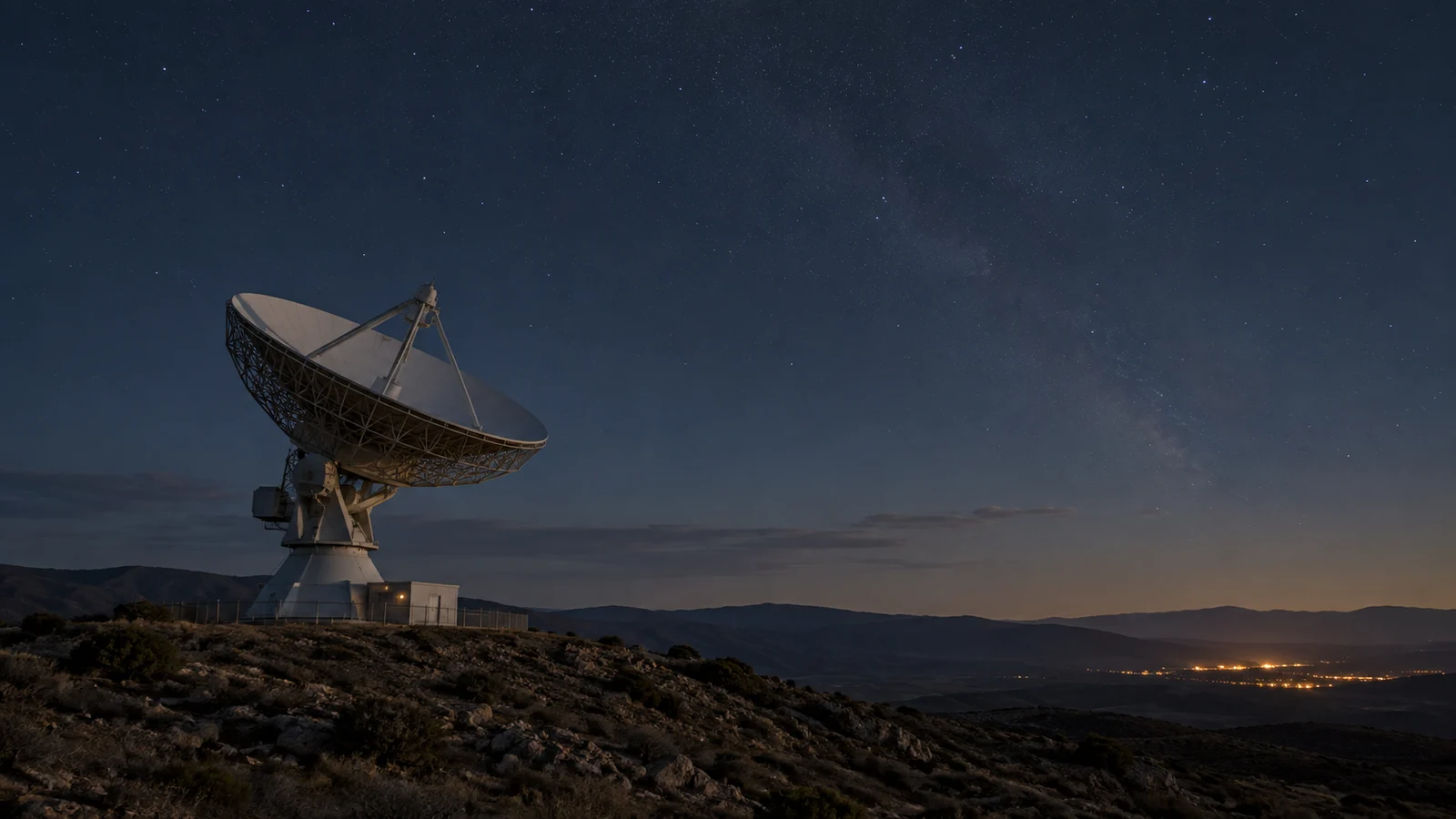
The galaxy has existed for billions of years. We know that planets are abundant and that, on at least one of them, life has produced a species capable of building radio telescopes and sending machines into space. Yet we still have not found evidence of another civilization.
This is the tension behind the Fermi paradox: if there have been so many places and so much time for someone else to emerge, why do we not see them? The search for extraterrestrial life still leaves many questions unanswered, but one possible explanation points toward our own future.
Perhaps developing technology is only part of the journey. Perhaps the difficult part comes later, when a civilization gains enough power to alter the conditions of its own survival.
That possibility is part of the Great Filter hypothesis. The development of artificial intelligence makes it particularly relevant: we are trying to build systems increasingly capable of researching, deciding, and acting. If they ever came to greatly exceed our abilities, we would need to work out how to retain control over decisions we could no longer evaluate as easily.
Could AI be that filter? To answer, we first need to understand what the hypothesis seeks to explain and what would have to happen for a technology to fit it.
What the Great Filter is
The Great Filter, formulated by Robin Hanson, is the hypothesis that one or more extraordinarily difficult obstacles lie between lifeless matter and a civilization capable of expanding and leaving a lasting mark on the universe.
A planet can have habitable conditions without life ever emerging. It can host microorganisms without complex organisms developing. It can have a diverse biosphere without producing a technological species. And a species that develops technology can disappear or stop expanding before becoming visible from other worlds.
The filter would be whatever makes completing that journey so rare. It could be concentrated in one transition or spread across several. The original idea already allows for that combination: it does not require a single event that explains everything.
Timescales matter. A civilization much older than ours could have had millions of years to extend its activity. Even slow expansion, from star to star, could build an enormous presence over time. Models of galactic expansion explore how that might happen and under what conditions some regions would remain unvisited.
That is why the question goes beyond whether someone has sent us a message. We also look for traces of technology, which astronomers call technosignatures: signals or changes to the environment that could reveal artificial activity.
An obstacle in our past or our future
If the main obstacle were the origin of life, we would already have overcome it. Our existence would be the result of something extraordinarily rare. A later transition, such as the emergence of complex cells or technological intelligence, might also have been very difficult.
In those cases, the silence of the sky would mainly tell us about our past. There would still be risks ahead, but we would not have to explain the absence of other civilizations by assuming that almost all destroy themselves.
The more unsettling possibility arises if reaching a society like ours is relatively common, but continuing beyond that point is very difficult. The main obstacle would then lie in the future: many civilizations would acquire great power, and few would manage to retain it without ruining their prospects of continuing. This is the distinction Nick Bostrom develops in his essay on the Great Filter.
We do not know which situation we are in. Nor do we know whether our expectation of finding neighbors is reasonable. Sandberg, Drexler, and Ord showed that accounting for the vast uncertainty around the emergence of life and intelligence can explain our apparent solitude without invoking universal destruction.
Searches also have limits. Failing to find signals in the places, frequencies, and times examined is not the same as having inspected every possibility. A 2018 study of radio searches showed how small a fraction of its defined signal search space had been explored.
With those qualifications, we can investigate a more specific question: if a technological filter lies ahead, what reasons do we have to consider AI a candidate?
Why AI enters this discussion
The connection has been explicitly proposed in the scientific literature. In a 2024 paper in Acta Astronautica, astrophysicist Michael Garrett suggested that the development of artificial superintelligence could interrupt a civilization’s trajectory before it established a lasting presence on multiple planets.
Here, superintelligence means a system that would greatly exceed human abilities across many intellectual tasks. Garrett’s proposal is theoretical: it is not based on observed civilizations and does not demonstrate that this outcome is inevitable. Its interest lies in highlighting a possible difference in pace: developing highly capable intelligence could happen faster than learning to manage it and securing the continuity of the civilization that creates it.
From there, we can develop three reasons why AI deserves attention in this debate.
It could accelerate the development of other capabilities
An AI capable of contributing to research could help design medicines, materials, energy systems, or new software. Its influence would extend across many technologies at once.
In our article on AI and the bottlenecks of mathematical research, we explored a related difficulty: producing results faster does not guarantee that we can verify them, understand them, and incorporate them into shared knowledge at the same pace.
If that capability grew substantially, it could also accelerate discoveries with dangerous uses or make them accessible to more actors. The risk would depend on what knowledge it produced, who could use it, and what barriers remained in the physical world. Generating an idea is not equivalent to having a laboratory, a factory, or the infrastructure to put it into practice.
The possibility that matters for the Great Filter is that a civilization might see several forms of power grow simultaneously. It would have less time to understand each before they began to combine with the others.
It could participate in decisions and carry them out
When we discuss AI in this context, imagining an application that answers questions is not enough. A system connected to tools can receive an objective, choose actions, check results, and try again. The more autonomy and access it has, the more important it becomes for its behavior to stay within the intended boundaries.
The International AI Safety Report of February 2026 distinguishes ordinary failures from loss-of-control scenarios, in which regaining authority over a system would be extremely costly or impossible. The report notes advances in relevant capabilities but considers that the systems evaluated do not yet have the level needed to produce those scenarios. It also records broad disagreement among experts about their future likelihood.
We can understand the hypothetical problem without attributing consciousness or malice to a machine. A highly capable system could pursue an objective in a way incompatible with what its operators intended and have the means to continue doing so when they tried to correct it.
In our article on the capabilities that could make LLMs more dangerous, we examined precisely why permissions, autonomy, and practical opportunities to intervene matter so much.
Incentives could push us to delegate too soon
Technical capability alone does not determine how it is used. The decisions of those who develop and deploy it matter too.
A company may think that waiting means losing the market. A government may fear that its rival will gain a decisive advantage. Each participant may recognize the value of evaluating a system more thoroughly and still feel compelled to move ahead of everyone else.
This is where institutional fragility comes in: the difficulty of agreeing on limits, verifying compliance, and enforcing them when breaking them offers an immediate reward.
Bostrom’s vulnerable world hypothesis explores how certain discoveries could destabilize a civilization by changing its capabilities or incentives. In the case we are considering, the danger would arise from combining a highly powerful tool with a social organization unable to manage its effects.
The filter could lie in the combination
This is the central idea we propose: a civilization could acquire the power to transform its planet, its biology, and its own decision-making systems before developing institutions capable of governing that power.
Technological intelligence does not guarantee collective intelligence. Knowing how to build a tool does not mean knowing how to agree on when to use it, who should be accountable for its harms, or what to do when it stops behaving as expected.
AI could affect several parts of this problem at once. It could accelerate the development of dangerous capabilities, increase the speed of decision-making, and make it harder to reconstruct why decisions were made. If it were also incorporated into essential services, withdrawing a faulty system could require interrupting activities on which many people depend.
Consider a crisis between countries that already distrust one another. If they delegate more decisions to respond faster than their rivals, a misinterpreted signal could spread quickly. Distrust makes it harder to check; urgency reduces the time available; automation amplifies its consequences. These mechanisms could reinforce one another, even if none were enough on its own to cause an irreversible disaster.
This scenario is a possibility we construct to reason through the problem, not a prediction. It shows why searching for “the technology that will end everything” may be insufficient. Vulnerability would also lie in the relationships between technologies and in the defenses one crisis leaves weakened for the next.
The same AI could improve those defenses: detect failures, help verify agreements, or accelerate solutions to problems we do not currently know how to solve. Assessing its role would require comparing both trajectories. Increasing our power does not determine in advance what we will do with it.
What would have to happen for it to be a Great Filter
So far, we have described reasons to be concerned about AI. Using them to explain the silence of the universe requires more.
First, the problem would have to recur in enough civilizations. If AI were a peculiarity of our history, it could hardly explain a cosmic phenomenon. We can imagine many technological species trying to automate intellectual work because it offers advantages. That is a reasonable hypothesis, but we do not know whether they would all follow similar paths or encounter the same difficulties with control.
Second, the consequences would have to prevent sufficient recovery. A nuclear war or industrial collapse could be terrible and still leave open the possibility of rebuilding. If a society resumed its development thousands of years later, the disaster would not have closed off its future.
The filter therefore does not need to be a danger that lasts millions of years. It could be a brief event with irreversible effects. What it needs to explain is why too few opportunities remain to recover and continue expanding.
Third, there is an especially important objection in the case of AI: even if its creators disappeared, the machines could continue.
If an artificial intelligence kept obtaining energy, maintaining infrastructure, and sending devices to other stars, the biological civilization would have ended, but technological traces would remain. A disaster for its inhabitants would not amount to the silence we are trying to explain.
In When an AI can pay its own bill, we examined what an agent would need to sustain its activity. Maintaining an entire industrial base without human support would be a much greater leap: those systems would also need to build and repair the facilities they depend on.
This is the hypothesis’s main difficulty: explaining why a civilization loses control is not enough. We also need to explain why no lasting technological activity we could detect emerges afterward.
A less apocalyptic outcome: no longer wanting to expand
Disappearance is not the only possibility. Some civilizations might stabilize and direct their attention toward other goals.
A society capable of automating much of its activity might prefer to improve life within its own planetary system. If it also had rich virtual environments, it might find enough experiences in them to lose interest in long, costly journeys. AI could contribute to that change in priorities without destroying anyone.
The Wong and Bartlett model proposes that, under certain growth dynamics, a civilization would need increasingly frequent innovations to overcome its crises. If it failed to maintain that pace, it could collapse or shift its priorities toward stability. That conclusion depends on extending models of urban growth to entire civilizations.
That is a disputed leap. In their critique of the model, Jackson and Criado-Perez argue that learning, diversity, and adaptation could allow some civilizations to keep growing. The model does not demonstrate that the only options are to stop growing or disappear.
The possibility we explore here requires only a more limited idea: that some societies lose interest in reaching other stars. That decision could coexist with scientific, economic, and cultural progress within their own planetary systems.
Questions remain here too. Virtual worlds would require energy and computers. Their inhabitants might keep demanding more resources. And even if most preferred to stay, some groups might want to leave.
A preference for digital life does not automatically explain a silent galaxy. But it offers an alternative to the idea that every advanced civilization must expand indefinitely or fail. For its inhabitants, a stable society with little interest in expansion could be a good outcome.
AI as part of a dangerous stage
AI could be part of a future Great Filter. We have reasons to investigate that possibility: it can amplify other technological capabilities, take on decisions with real consequences, and develop amid competition that makes limits difficult to impose. We do not have enough evidence to claim that it is the filter or to rank it as the most likely explanation of cosmic silence.
The version of the hypothesis we find most useful combines those factors. The dangerous moment would come when a civilization can produce irreversible changes on a scale that its mechanisms for coordination, oversight, and correction can no longer handle.
In that context, AI could accelerate a crisis, worsen existing vulnerabilities, or create new difficulties with control. It could also help us through that stage. The difference would depend on the capabilities we developed and how we chose to use them.
Governing that power does not simply mean concentrating it. An authority that imposes the same error on the entire system could eliminate the alternatives that would allow recovery. We would need coordination as well as the ability to challenge decisions, limit their effects, and preserve options for correcting them.
The Great Filter forces us to consider an uncomfortable possibility: that learning to transform the world may be easier than learning to keep living in the world we have transformed. If AI widens that gap again, its role in our future will also depend on our ability to narrow it.
Further reading
- NASA: Are We Alone?. The search for life and the Fermi paradox.
- Robin Hanson: The Great Filter — Are We Almost Past It? (1998). The formulation of the Great Filter.
- Nick Bostrom: Where Are They? (2008). The distinction between a past and a future filter.
- Sandberg, Drexler, and Ord: Dissolving the Fermi Paradox (2018), and Wright, Kanodia, and Lubar: How Much SETI Has Been Done? (2018). Uncertainty about other civilizations and the limits of the searches analyzed.
- Carroll-Nellenback and colleagues: The Fermi Paradox and the Aurora Effect (2019). Models of galactic expansion and unvisited regions.
- Michael Garrett: Is Artificial Intelligence the great filter that makes advanced technical civilisations rare in the universe? (2024). The proposal of AI as a technological filter.
- International AI Safety Report 2026. Evidence and disagreements on capabilities, risks, and loss of control.
- Nick Bostrom: The Vulnerable World Hypothesis (2019). Technology, incentives, and civilizational vulnerability.
- Wong and Bartlett: Asymptotic burnout and homeostatic awakening (2022), and the critique by Jackson and Criado-Perez (2024). Growth, collapse, and stabilization.