On 3 September 2026, Sharif Shameem published a recreation of San Francisco’s Palace of Fine Arts which, he explained, he had built with GPT-6 Astra in Blender. Two days later, Simon Willison documented another assignment for the same application: a pelican riding a bicycle. He shared the result, the scripts and the scene files.
The building was more spectacular. The pelican had more history. In October 2024, Willison was already asking language models for that animal on that vehicle. Back then, he expected a drawing made with code. Now he could open the result in a 3D production tool.
Between those two assignments lies a small history of AI progress. On social media, that history is told through badly drawn birds, tiny video games and balls passing through walls. These tests have preserved something that score tables explain less well: what we found hard to believe at each moment.
Watch the original video on X
A test you understand before reading the explanation
A formal benchmark tries to measure a capability through defined tasks, conditions and criteria. A playground test starts differently: someone proposes something, shows the result, and other people decide to try it too.
Its advantage is that viewers already know much of what should happen. A bicycle has two wheels. A bird needs some recognizable relationship with the pedals. A ball inside a container should not pass through it. A game character has to respond to the keys.
That familiarity lowers the cost of participating. To interpret a score, we need to understand what is being assessed and what it is compared against. To notice that a ball has escaped, we only need to look. A visible failure can also be pointed out, discussed and tried again with another model.
Humor makes the assignment memorable. Repetition makes change recognizable. Each new release meets a small battery of questions that nobody has formally approved, but that a community already shares.
The ease of seeing a result also introduces a bias: tasks that produce something striking are easier to remember. A successful migration, an optimized query or a bug that is difficult to reproduce may matter much more while making a considerably worse video.
Before the pelican, someone tried to eat spaghetti
In March 2023, Reddit user chaindrop published a ModelScope-generated video of Will Smith eating spaghetti. The face, pasta and movements warped in a way that was hard to forget. That result became a recurring reference for comparing video models.
Watch chaindrop’s original March 2023 video on Reddit.
Here is a first distinction: generating frames of a person eating and writing the program for an animation are different tasks. They share the viral test format, but they do not form a single technical scale.
They also share the risk of comparisons losing context. In February 2024, Will Smith himself filmed a real parody of himself eating pasta and presented it alongside the old video. Some people interpreted the montage as an improvement in video generation. The supposed new result was the actor making a joke, as Ars Technica documented.
An image is easy to understand. Finding out where it comes from can take more work.
The comparison is incomplete if it stops there. On 10 February 2026, Carlos Santana, @DotCSV, published a version of the same assignment made with Seedance 2.0. It provides a recent endpoint with an identified author, model and date: we can return to the 2023 video and watch what happens to the face, hands and pasta throughout the movement. The date belongs to the original, not a later repost of the clip.
Watch the original video on X
Code gained a showcase
In June 2024, Anthropic introduced Artifacts alongside Claude 3.5 Sonnet. The model’s creations could appear in a window next to the conversation, where users could see them and keep modifying them.
That interface change matters when explaining the popularity of games and small applications. Asking for Pong, Snake or an HTML page produced something easy to show. Users could interact with it and record a few seconds without turning the conversation into a tutorial on running code.
On 20 June, Nick Dobos published exactly that example: he had asked for Pong and was showing the game inside Artifacts. Two paddles, a ball and a score were enough to recognize the assignment. Code no longer had to be copied elsewhere before checking whether it was useful: the conversation and its result shared a screen.
Watch the original video on X
Model improvements and reduced friction reinforced each other. When a capability is easier to try, more people find uses, errors and variations. The showcase also helps people discover what the tool can do.
In December 2024, WebDev Arena gave that comparison a more organized form: the same request went to two models and users chose the result they preferred. The version Willison examined focused on React, TypeScript and Tailwind. It measured preferences within that particular environment; its name should not be read as an evaluation of all web development.
In September 2026, the “game in one HTML file” format was still alive. On the 4th, @claudeebum showed a draft of Mario level 1-1 generated with Astra in a single file. According to the post, it took two minutes. The container was the same as in 2024; it now held a level, scrolling and more rules of play.
Watch the original video on X
That same day, @AiBattle_ published two versions of a 3D Sonic game built in Godot with Astra, one at medium reasoning effort and one at maximum. Here the environment changes too: Godot is a game engine with tools for scenes, animation and physics. Watching both demos makes the leap from Pong clearer than listing the model versions released in between.
Watch the original video on X
The pelican put everyone in front of the same drawing
On 25 October 2024, Willison published a comparison of 16 models with a short request:
Generate an SVG of a pelican riding a bicycle
SVG is an image format that describes shapes through code: circles, lines, curves, colors and positions. The model had to write instructions that would compose a recognizable scene when opened in a browser.
Willison chose the combination because he likes pelicans and thought that particular SVG was unlikely to appear in the training data. It was an intuitive precaution, not a guarantee that the example was absent.
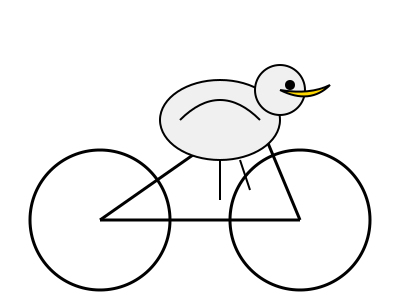
Sonnet · June 2024

Sonnet · October 2024
The drawing brings several demands together. The pieces must appear, keep their proportions and relate to each other. A bird near a bicycle does not quite fulfill the same assignment as a bird riding it.
That lets us discuss composition and instruction following. Claiming that the result demonstrates a general understanding of space would require additional tests. The distinction matters precisely because the example is useful: it reveals differences without needing to attribute more to it than it shows.
The pelican eventually left the comparison posts. On 20 May 2025, it appeared briefly in the Google I/O keynote, an appearance Willison recorded on his blog. The reference was recognizable enough to enter a manufacturer’s presentation.
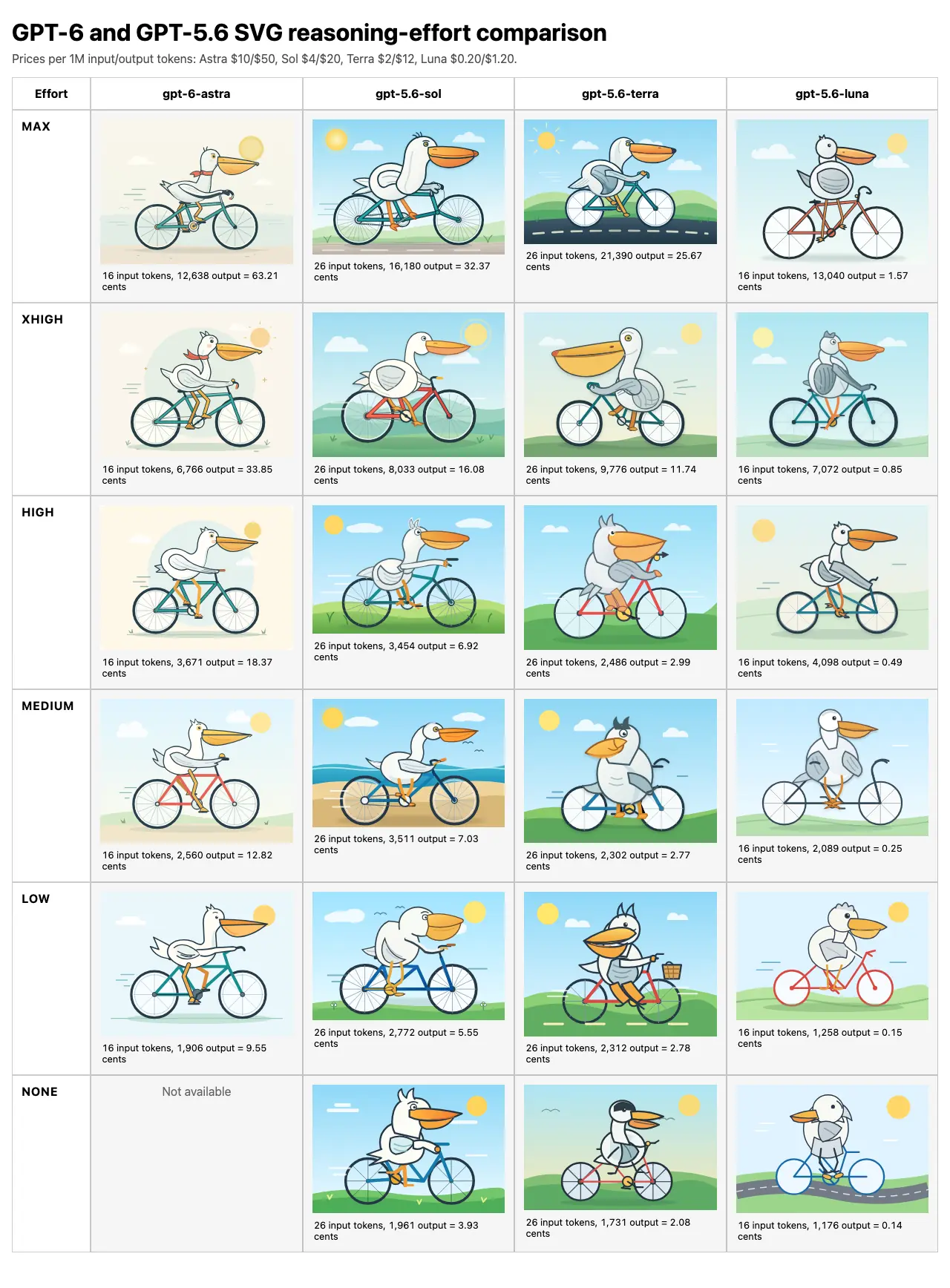
The same drawing also has a version from this week. On 4 September 2026, Willison published a grid of Astra’s SVG pelicans alongside those from GPT-5.6 Sol, Terra and Luna at different reasoning levels. We are no longer comparing only the two Sonnet versions from 2024: we can inspect the same assignment with current models. Even here, details remain unresolved; Willison notes that below maximum effort, Astra does not reliably place the legs on both sides of the bicycle frame.
On 1 September, he had also taken the SVG from Fable 5.1 at maximum effort and asked it to animate it using high effort. The bird now pedals. The video is an export of that SVG; the author notes that the wheels appear to turn backward in the MP4 and attributes the effect to conversion. The visual improvement comes with a process we can reconstruct.
With the hexagon, you had to wait for something to happen
On 31 January 2025, Flavio Adamo published a comparison between o3-mini and DeepSeek R1. He asked for a Python program with a ball inside a spinning hexagon, subject to gravity and friction, with realistic bounces against the walls.
The assignment added a time dimension. A screenshot might look right, then a few seconds later the ball could pass through a side or get stuck in a corner.
Watch the original video on X
A moving wall has consequences: it can transfer velocity to the ball. A solution has to account for how both are moving at the collision point, while preventing simulation steps from allowing the ball to cross the boundary. Viewers can intuit that difficulty even if they have never programmed a collision.
On 18 February, Theo published a Grok 3 result that failed the same exercise. The video shows the other half of the test’s appeal: a release might arrive with impressive scores and find, on opening X, a ball that would not obey the container’s rules.
Watch the original video on X
But an attractive animation can hide an incorrect simulation. And a failure in one run does not, by itself, establish two models’ positions in an overall ranking. We would need to know the attempts, instructions, reasoning mode and criteria used to decide what counts as success.
The hexagon teaches something useful about these tests: watching for longer can change the verdict. The same idea applies to a game that works until you restart it or a page whose most striking button does nothing.
The update from 5 September 2026 makes the question harder: dozens of balls of different sizes, collisions between them and a central obstacle rotating in the opposite direction. Tom Farnschläder published a run with Astra and another with Fable 5.1 on DataCamp, both with high reasoning and the same tools. According to his review, both kept the balls inside for thirty seconds; Fable showed some sticking to the walls. Each model completed one run of the assignment with access to tools, so this does not reproduce the conditions of 2025 either.
Blender was already there; the assignment is changing
The connection between language models and Blender did not begin in September 2026. On 11 March 2025, Siddharth Ahuja introduced Blender MCP with a demo of a low-poly dragon guarding treasure.
MCP provides a way to connect an assistant to tools. In this case, the integration made it possible to query the scene, create and modify objects, and execute code in Blender. The bridge to a 3D application already existed.
Watch the original video on X
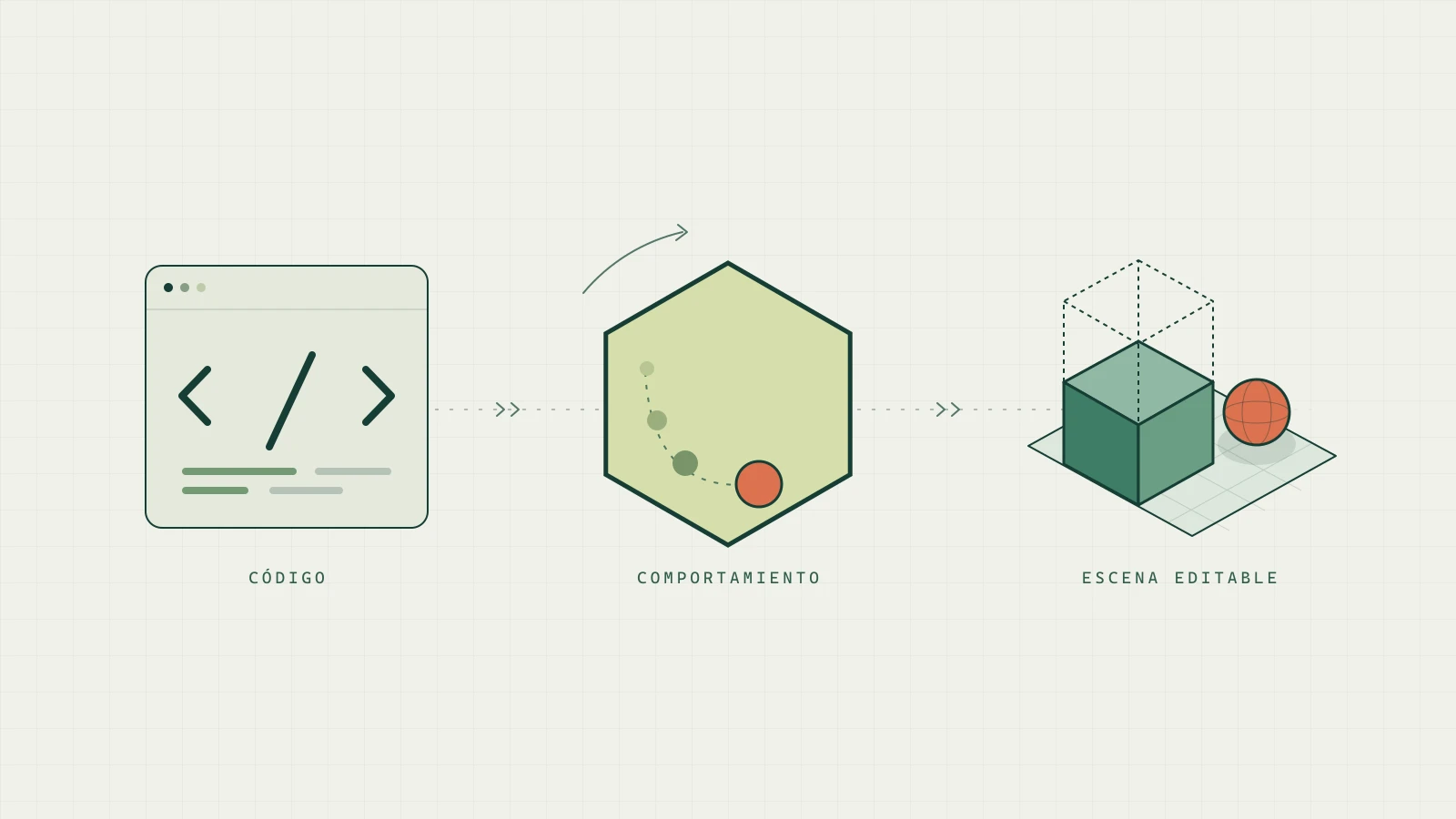
The example Willison documented on 5 September 2026 takes another route: a coding agent executes scripts through Blender’s Python API, which allows code to control the application. It does not need to reproduce every click a person would make.
After the first pelican, he asked for a background and more detail. Then he requested another improvement. He published the files from all three stages and the conversation. That documentation makes it possible to distinguish the initial result from work accumulated through revisions.

The type of result changes what we can ask for next. A scene contains objects, materials, lights and cameras. If its structure is well built, we can change one part and render it again: calculate a new image from that scene.
Being able to preserve and edit that structure matters as much as the video’s finish. It opens up assignments such as keeping an object consistent across shots, changing the camera or adjusting a light without rebuilding everything. It also allows the work to be inspected from the inside.
Another example from that week broadens the assignment. On 4 September, Duncan Trussell published Backrooms: horror-styled corridors with VHS tape effects. According to his account, Astra built the scene in Blender and made the sound effects too. He reported around five instructions, thirty minutes of creation and another twenty to export.
Watch the original video on X
The video combines atmosphere, a walkthrough and audiovisual finishing. Compared with that earlier Pong, what matters is how many different kinds of work now fit inside an assignment. The result may resemble a video generator’s output; the process Trussell describes involves building and rendering a scene in a 3D application.
That does not automatically make every file ready for production. We would need to examine its organization, geometry and behavior when modified. But we now have a more concrete question than whether the image is impressive: which parts of the delivered work can we keep using?
When everyone knows the question
Popularity introduces a paradox. The pelican prompt began as an attempt to find an unusual combination. As it is repeated, its results become part of public discussion. It is reasonable to ask whether an improvement reflects a broad capability or specific preparation for the exercise.
Dylan Castillo tried to investigate that suspicion in July 2026. He generated 1,008 SVGs with seven models, combining eight animals and six vehicles. That let him compare the cycling pelican with other scenes instead of looking only at the famous prompt.
He found no statistically clear advantage for that particular combination. The study had limits: three samples per combination and model, a model judging the images, and no way to detect general optimization of SVG generation. It does not show that specific training is impossible; nor does it justify assuming it happened. Methodology, results and code.
Changing the animal and vehicle is a simple way to improve the question. So is changing the container’s shape or requesting a modification to an existing scene. If the capability holds up when relevant conditions change, we learn more than by repeating the same assignment indefinitely.
The next test may be preserving what already works
These demos deserve attention. They make a capability visible, invite people to try it and provide a shared language for discussing its failures. A good example can teach us more about a particular behavior than an aggregate score whose meaning we barely understand.
What a post rarely shows is how many attempts were needed, which instructions came afterward or how much work the environment contributed. Giving a model one chance to write code and allowing an agent to run it, inspect the result and correct it are two different conditions. To compare progress, it helps to know which one we are seeing.
Our expectations have changed too. At first, something recognizable was enough. Then we wanted it to run, respond and keep working after a few seconds. Now some demonstrations deliver a project we can open and continue.
The pelican helps us remember that shift without turning it into a race of names and versions. The Blender scene preserves a joke from 2024 while opening up assignments that the earlier drawing could not support.
Perhaps the next playground test will ask for something less striking: move a camera without changing the scene, fix a collision without breaking the game, or add a feature while preserving the existing ones. For a while, we asked whether the pelican could get on the bicycle. Now we can start checking whether it keeps pedaling after we change everything around it.
Watch Mysuru Palace with Astra · MV Karan · 5 September 2026
We ended up combining the tests into a game
After preparing this article, we combined several of its tests into Pelican Grand Prix, a racing game built with Codex and Three.js. The main character is a pelican on a bicycle riding around a vertical hexagonal circuit, with another hexagon spinning in the opposite direction and balls bouncing between them.
We refined it by playing: adjusting the brake, rewarding drifts and fixing what happened when brushing against the side of a ramp. The result reflects several rounds of instructions and corrections. It is an experiment we are still improving, and a way to try out the question at the end of this article.
Opens in your browser. The game is in English, with keyboard and touch controls.
Sources
- MV Karan — Mysuru Palace, 2026-09-05.
- Carlos Santana — Seedance 2.0, 2026-02-10.
- @claudeebum — Mario 1-1 / Astra, 2026-09-04.
- @AiBattle_ — Sonic / Godot / Astra, 2026-09-04.
- Simon Willison — The Pelican comparison grid for Astra is pretty interesting, 2026-09-04.
- Simon Willison — Claude Fable 5.1 made me a really nice animated pelican, 2026-09-01.
- Tom Farnschläder — GPT-6 Astra vs Claude Fable 5.1, 2026-09-05.
- Sharif Shameem — Palace of Fine Arts, 2026-09-03.
- Simon Willison — Using Blender with coding agents on macOS, 2026-09-05.
- Chaindrop — Will Smith eating spaghetti, 2023-03.
- Ars Technica — Will Smith parodies viral AI-generated video by actually eating spaghetti, 2024-02-20.
- Anthropic — Claude 3.5 Sonnet, 2024-06.
- Nick Dobos — Pong / Claude Artifacts, 2024-06-20.
- Simon Willison — Pelicans on a bicycle, 2024-10-25.
- Simon Willison — WebDev Arena, 2024-12-16.
- Flavio Adamo — o3-mini / DeepSeek R1, 2025-01-31.
- Theo — Grok 3, 2025-02-18.
- Siddharth Ahuja — Blender MCP, 2025-03-11.
- Blender MCP — GitHub.
- Simon Willison — Google I/O, 2025-05-20.
- Dylan Castillo — Are AI labs pelicanmaxxing?, 2026-07-18.
- Duncan Trussell — Backrooms / Astra / Blender, 2026-09-04.