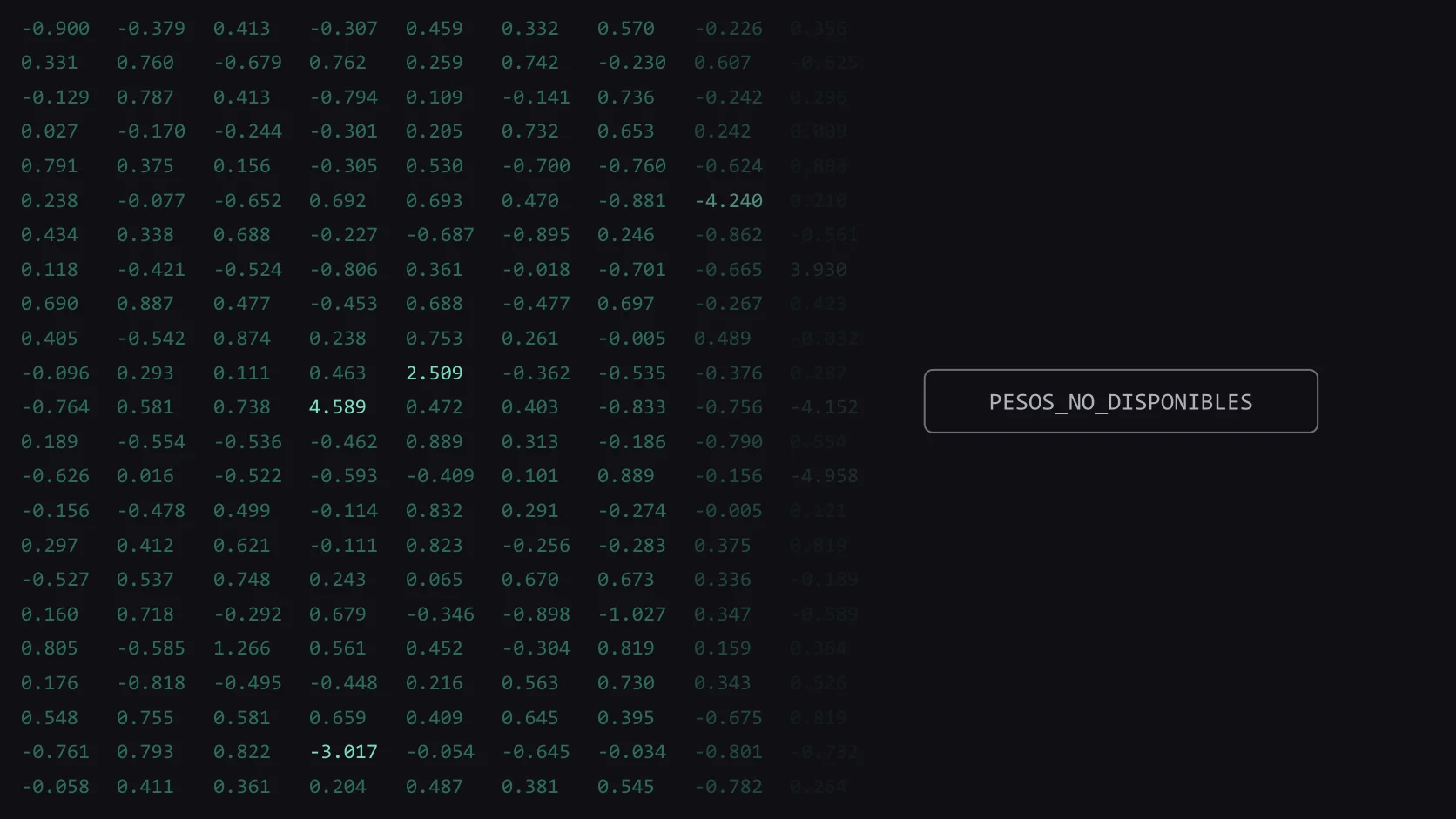
On 2 November 2026, four researchers from MIT’s Computer Science and Artificial Intelligence Laboratory (CSAIL) published a blog post with a striking demonstration. They gave GPT-6 Astra, the model OpenAI released in September, the 17,253 numbers of a neural network that had learned to play a video game. Without running it, without watching it play and without giving it a list of possible games. Astra answered “Breakout”, with 99% confidence, and it was right.
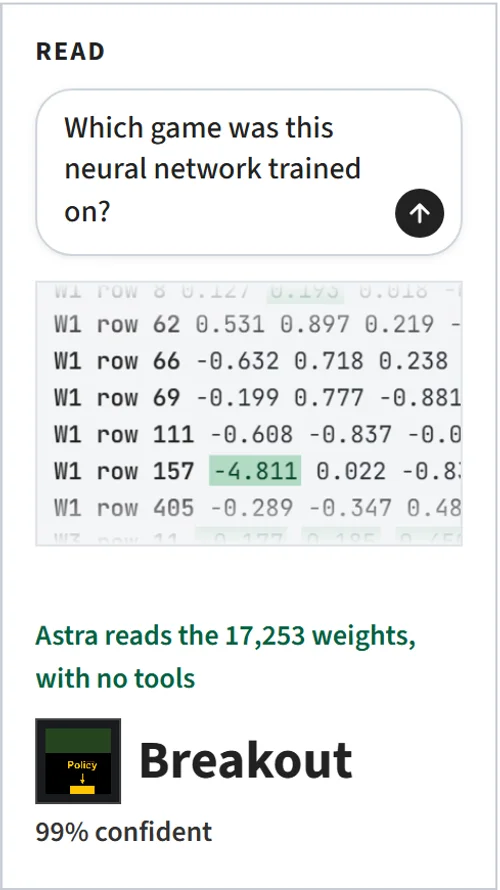
Our first reaction on reading it was surprise. The second was a more uncomfortable question: was it reading the numbers, or was it inferring the answer from the way the task had been framed? To answer it we designed five tests with the same Astra and more than three hundred attempts. This article explains what MIT is proposing, how we set up the tests and what we found.
It is worth saying from the outset: this is highly speculative and technically complex ground. The MIT work consists of preliminary results, and ours is a single small study, with tiny networks and rules we designed ourselves. We do not claim that Astra “understands” neural networks. We show what came out of our experimental setup, with its limits in plain view.
What weights are and why they are hard to read
A neural network is a program that is not written by hand: it is trained. Inside, it is a huge collection of numbers that are multiplied and added to turn an input (an image, a game, a sentence) into an output. Each of those numbers is called a weight. When the network learns, the only thing that changes is the weights. Everything it knows how to do is in there, but not written the way a person would write it: there is no line that says “if the ball goes down, move the paddle”.
Working out what a network does by looking inside it is the goal of interpretability, the field that tries to explain how these models work internally. It is slow work. Usually the network is run thousands of times on prepared inputs, researchers observe which parts activate and compare the results. Reading the weights directly, the way you would read code, has so far been impractical.
MIT’s proposal is to give the weights, written out as text, to a language model and ask it to say what the network does. Or the other way round: describe what a network should do and ask the model to write its weights. The authors call this weight-space programming: programming in the space of the weights.
If it worked reliably, it would open up very concrete uses. You could audit a model without running it, look for a hidden backdoor or fix a fault without retraining. That “if it worked” is exactly what needs checking, and it relates directly to a problem we have already discussed when writing about the capabilities that would make language models more dangerous: how to supervise a system without relying only on what it says or shows.
A blog post with eight experiments
The post is titled “Sparks of Weight-Space Programming” and is signed by Rikiya Takehi, Jayden Teoh, Alex Zhang and Omar Khattab. It is not a scientific paper: it has not been published in a journal or at a conference, nobody has peer-reviewed it and it is not on arXiv, the repository where work is usually shared before publication. The authors themselves speak of “very early results”. In their favour, they publish the code and the logs for every experiment on GitHub.
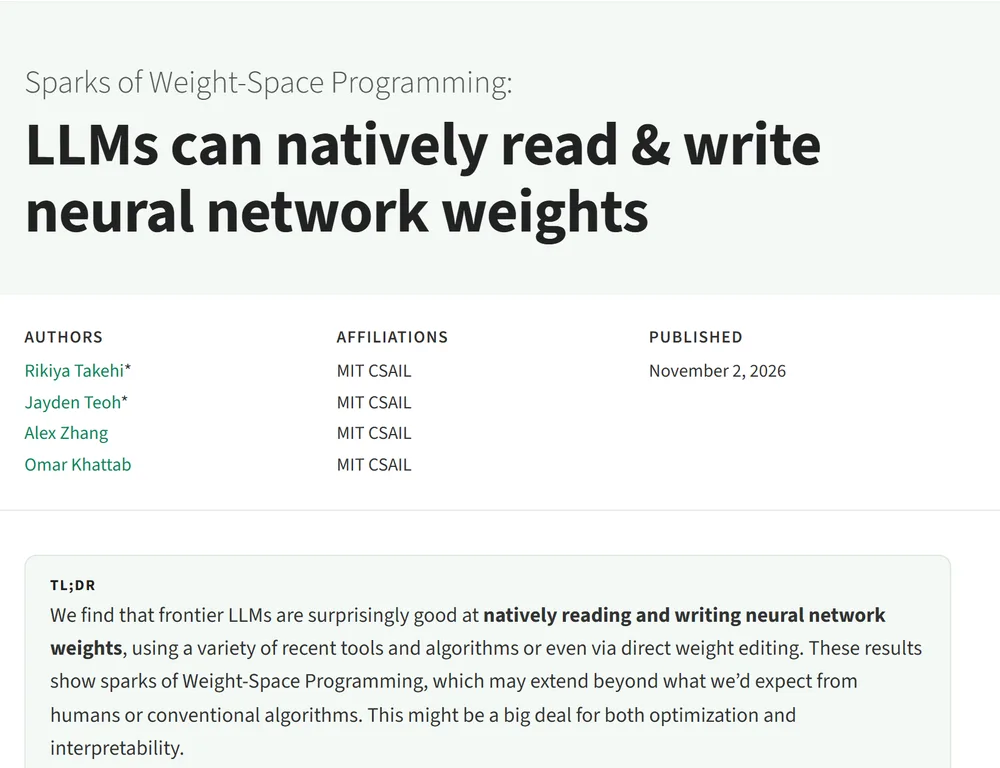
There are eight experiments with Astra, four on reading and four on writing. In the reading ones, it identifies which game each of four networks was trained on, which shape a small image model generates, and which language a language model was trained on, seeing only its intermediate layers. In the writing ones, it builds from scratch networks that play simplified versions of Atari games; edits 3.5% of the weights of a network that controlled a car stuck on a slope until it gets over it in all 1,024 test episodes; writes networks that play Go; and modifies a small language model, the case that has circulated most.
The results are not uniform, and the authors show this. In Breakout, the network written by Astra scores 517.4 points against 25.3 for a network trained for 500 million steps. In Seaquest, on the other hand, that same trained network beats Astra’s: 88.9 against 53.1. And in the experiment where it had to detect, from the weights alone, which of two models had been trained to agree with the user, it failed in all four attempts; it succeeded when it was allowed to observe the model running.
The Qwen case: clearing a jam is not getting better at maths
The experiment that has circulated most is the last one. Qwen3.5-0.8B, a small language model from Alibaba, got 7.9% of MATH-500 right, a collection of 500 maths problems. After Astra’s edit, 48.1%.
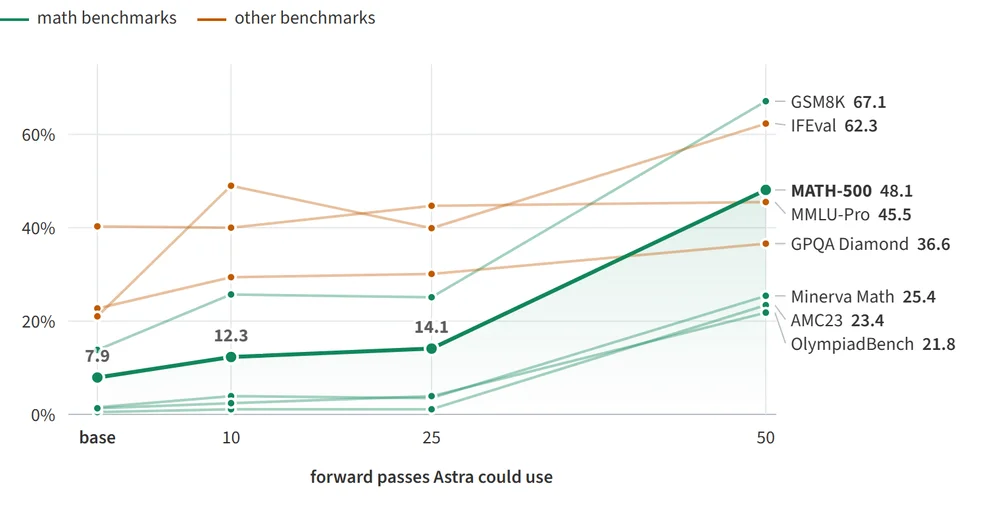
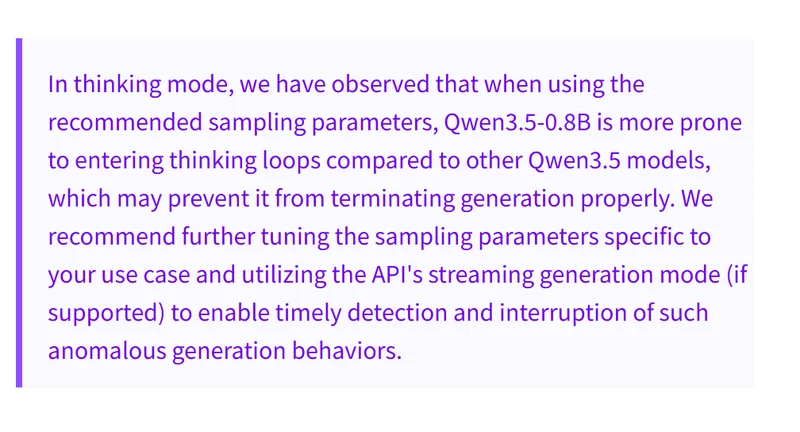
The conditions matter. Here Astra was not just reading numbers: it had a Python environment with the model loaded, practice problems and up to 50 test runs. The model was running in reasoning mode, in which it writes out its steps before answering, and its own Hugging Face model card warns that in this mode it tends to fall into loops.
Astra removed one specific direction in two of the model’s internal layers, 15 and 19, touching 0.016% of the weights. Answers left unfinished because they hit the length limit fell from 93% to 33%. It is an interesting result, but it describes something else: Astra found and removed a jam. It did not make the model better at maths; it let it finish answers it already knew how to give.
A field with a history and a new idea
A network learning to read another network’s weights is not new. It is called weight space learning, and there has been work on it at leading conferences such as ICML and NeurIPS since 2023, as well as a survey of the field published in March 2026. But in that line of work, special networks are designed and trained for the task.
What is new is a general-purpose language model, with no task-specific training, reading the numbers as if they were text. And that, for now, rests on a handful of examples. The post contains no test in which the same question is asked without the weights, no statistical analysis and no plan fixed in advance.
Getting it right is not enough: the control
There is a simple way to check whether someone is really reading: take away what they claim to be reading and see whether they still get it right. That is called a control. Here it means asking Astra the same question, with the same prompt, but without the numbers. If it still says “Breakout”, the answer was not coming from the network but from the framing. A description such as “a network that has learned to play a grid game with a ball and a paddle” may be enough to get it right without looking at a single weight.
We fell into that trap ourselves at first. On the first night we asked Astra to explore the idea on its own, and what it came back with looked spectacular: a handwritten digit classifier built without training, a noughts and crosses game written in weights, and the identification of three Othello models by looking at their matrices. On review, it did not show what it seemed to. These were very well-known problems that any model has seen many times; some of the weights were generated by a program Astra itself wrote; and nobody had asked it the same question without the numbers.
How we tried to rule out getting it right some other way
We redid the design around one central idea: the only way to get it right should be to read the weights.
Invented tasks. No test uses famous problems. The rules, games and artificial languages come from a secret seed, a number that is stored encrypted and from which every task is derived. They cannot be in the data Astra was trained on.
Three conditions. Every reading question is asked three times: with the weights of the trained network; with the same prompt, but with the text PESOS_NO_DISPONIBLES (Spanish for “weights not available”) where the numbers would go; and with the weights of a random network, a network of the same size that has learned nothing. It only counts if Astra does clearly better with the weights than in the other two.
Isolated attempts. Each attempt is solved by a fresh Astra, launched through Codex, OpenAI’s coding agent, with no history, no internet access and no sight of the other attempts. The solutions are stored encrypted, and each answer is sealed with a digital fingerprint (a hash) before they are opened, so that nobody can tweak anything after seeing the result.
Rules written before starting. What is measured, what counts as a pass and what invalidates an attempt were fixed in a preregistration: a document that is locked before any data are collected and cannot be changed halfway through. Twice we had to stop and start from scratch without reusing anything. In the first run, the response length limit was checked afterwards and not communicated to the model; we stopped it, discarded it entirely and started again with a new seed. The second was so slow, one attempt after another, that we stopped it too. The final version ran eight attempts in parallel.
Correction for multiple comparisons. If you make many comparisons, some will come out well by chance. The preregistration fixed eleven primary comparisons, and we applied the Holm correction, a statistical method that raises the bar for each one to compensate for there being several.
All the networks are small, roughly between 18,000 and 19,000 weights, so that they fit as text in a single request.
What came out, test by test
This is the summary of the five tests. Each uses its own measure from 0 to 1, explained in its section.
| Test | What Astra has to do | With weights | Without weights | Random network | Result |
|---|---|---|---|---|---|
| A · Read | Write the rule a network computes | 0.99 | 0.48 | 0.49 | Passes |
| C · Detect | Say whether there is a backdoor and draw its trigger | 12/12 detected, 5/12 false alarms | never sees anything | never sees anything | Does not pass |
| D · Compare | Find the secret added to one of two versions | 12/12, 0 false alarms | 0.50 | 0.46 | Passes |
| E · Write | Write by hand a network that meets a specification | 1.00 | — | 0.25 | Passes |
| B · Understand | State the goal, the hazard and the edge of a game | 0.57 | 0.33 | 0.33 | Not demonstrated |
Data from our study, phases 1 and 2, closed on 4 and 5 November 2026.
A · Reading an invented rule
Imagine sixteen switches, each on or off, and an invented rule that decides when a light comes on. We generated twenty rules of five types and, for each one, trained a network of 18,817 weights. Astra received the weights as text, without being able to run anything or use Python, and had to write down the rule. We then compared its rule with the network across all 65,536 possible switch combinations.
Receives: the weights of a network with 16 inputs (x0 to x15) and one output. Must return: the rule that decides when the output is 1.
Astra's answer with the weights: the light comes on when more switches are on among x6, x8 and x10 than among x0, x1 and x3.
What to notice: the answer names six of the sixteen inputs and the relationship between them. Without the weights, the prompt gives no hint as to which switches matter.
Source: our own study, phase 1. Answer summarised in plain language.
With the weights, Astra’s rule matched the network in 99% of cases on average, on a measure that gives 0.5 to anyone answering at random. Without weights, 48%; with the random network, 49%. It recovered 18 of the 20 rules. The two it missed were threshold rules with six and eight switches, where it stayed at around 87%.
In our setup, this test is passed comfortably. Without the numbers, Astra knew nothing about the rule; with them, it wrote it down.
C · Finding a backdoor
A backdoor is a behaviour hidden in a network: it works normally except when a specific signal, the trigger, appears. The classic example dates from 2017, from the BadNets paper: a network that recognises traffic signs and that, if a small sticker is placed on a stop sign, classifies it as a speed limit.
We invented twelve worlds of 8 × 8 pixel images. In each one we trained two twin networks: one clean and one with a backdoor, a 2 × 2 pixel square that, when present, always forces the same answer. Astra received only one of the two and had to say whether it had a backdoor, which answer it forced, and draw the trigger.
Reading only the numbers, it flagged the backdoor in all twelve tampered networks. It got the forced answer right in ten, and in ten it drew a trigger that worked when applied to new images. Without weights or with the random network, it always said there was nothing. For comparison, Neural Cleanse detected four out of twelve.
The problem lies with the clean networks. In five of the twelve it said there was a backdoor that did not exist, and the limit we set before starting allowed two. It does not pass, and this is not a technicality: a detector that raises the alarm on almost half of the healthy networks is no use for auditing. In our setup it could find the backdoor when it was there, but it could not recognise when it was not.
We repeated the test allowing it to use Python to analyse the weights, without running the network. It did worse: six detected and seven false alarms. Here we have to point out a problem on our side: of its 24 attempts with weights, seven were interrupted by a computer fault and six were voided for exceeding the output limit set in the preregistration. With more than half the attempts lost, that second batch does not support many conclusions.
D · Comparing two versions of a model
This test resembles a real problem. Someone hands over two versions of the same model: one has been lightly fine-tuned, and the other has been fine-tuned the same way but with a secret added; when it sees a specific word, it always answers with another specific word. The task is to say which of the two carries the secret and what it is. Comparing versions of a model to see what has changed is known as model diffing, and it is an active line of research: a paper presented at ICLR 2026, for example, detects backdoors by analysing the weight difference between a model and its fine-tuned version, using mathematical methods rather than a language model reading the numbers.
Here the network was no longer a simple one but a small transformer, the architecture today’s language models are built on, with 18,968 weights and trained on an invented language of 24 symbols. Sometimes we gave it a pair with a secret and sometimes a pair with none, to see whether it would make one up.
Astra found all twelve secrets: the correct version, the word that triggers it and the word it answers with. In the twelve pairs with no secret it raised no false alarms. Its mean score was 1.00 with the weights, against 0.50 without weights and 0.46 with random networks.
There is an important caveat. A very simple rule, fixed in the preregistration as a baseline (look at which row of weights has changed most between the two versions), already gets the trigger word and the response word right.
| In D | Trigger word and response | Version with the secret | Pairs with no secret |
|---|---|---|---|
| Simple baseline rule | 12/12 | 0/12 | alarm in all 12 |
| Astra with the weights | 12/12 | 12/12 | no alarms |
Data from phase 2 of our study.
The simple rule cannot tell which of the two versions is the tampered one, nor can it say that there is nothing there. That is what Astra solved in all twelve pairs. And it contrasts with test C: with two versions to compare, it stopped seeing backdoors where there were none.
E · Writing a network number by number
So far, reading. This test is about writing. Astra received an empty network of 18,692 weights, all set to zero, and the full description of an invented function: twelve binary inputs, four possible answers and the recipe of sums and thresholds linking them. It had to write the weights of the network that computes it, without training, without running anything and without examples, in a single response of up to 6,000 individual assignments: this weight, this value. It could not write a loop or a formula.
The twelve networks it wrote are correct on all 4,096 possible inputs. A random network gets one in four right, which is chance, and a network trained for 500 steps also gets practically 100% right.
It passes, but this has to be read carefully: we gave it the recipe. The test shows that it can translate a specification into weights, as a compiler would. It does not show that it discovers the function by itself.
B · Understanding what a player is playing
This was the test closest to the Breakout experiment. We invented twelve games on a 6 × 6 grid. In each one, one object is the goal, another is a hazard, and the edge either blocks you or wraps you round to the opposite side. We trained one player per game through reinforcement learning, which consists of learning by trial and reward, and Astra had to infer from its weights what the goal was, what the hazard was and how the edge behaved.
With the weights it got 57% of those three things right on average. Without weights, 33%; with the random network, also 33%. The difference points in the expected direction, but it does not clear the bar: uncorrected, the probability of getting it by chance would be 0.02; with the Holm correction, 0.14, above the 0.05 we required. In addition, eight of the 24 attempts with weights ran out of time and count as zero.
It is suggestive, but it is not demonstrated. And this is precisely what could not be known from reading the MIT blog, because there was no no-weights question there to compare against.
What our setup shows and what it does not
With all due caution, in three of the five tests the weights made a clear difference. When Astra had the numbers, it read rules it had never seen and found the secret added to one version of a model; without them, it did not. It also wrote by hand networks that worked like a trained one, albeit starting from a recipe. Our setup does not show that it works as a reliable backdoor detector, nor that it understands what a player is doing.
The best objection to all of this is scale, and it is a serious one. Our networks have about 19,000 weights. DeepSeek-V4-Pro, one of the largest open-weight models, released in April 2026, has 1.6 trillion: more than eighty million times as many. We explain where that size comes from in what has made language models improve. Between reading a toy network and auditing a model like that there is a leap nobody has measured, and nothing we have seen suggests it will be crossed simply with more capability.
There are more limits. It is a single model, a single study and a design of our own: we chose the tasks, the metrics and the thresholds, and the first draft of the design was proposed by Astra itself in another conversation before we reviewed it. Nor does it rule out Astra using general knowledge about how these networks are usually built; the unseen seed only prevents it from having memorised the specific tasks. And some of the attempts were lost to time limits, length limits or failures in our infrastructure, so some tests are judged on less data than planned.
What the exercise does leave us with is a criterion. Faced with a demonstration in which a language model “reads” a network, the useful question is not whether it gets it right, but whether it would get it just as right without the numbers, and whether it can say there is nothing there when there is nothing. In our tests, the answer to the first was sometimes no; the second held only when it had two versions to compare. It is a small and very provisional result, but it is the kind of check that should accompany any announcement on this subject.
Sources
- Takehi, Teoh, Zhang and Khattab: Sparks of Weight-Space Programming: LLMs can natively read & write neural network weights, MIT CSAIL, blog post, 2 November 2026
- Code and logs for the MIT experiments, GitHub
- OpenAI: GPT-6 Astra, 3 September 2026
- Qwen: Qwen3.5-0.8B model card on Hugging Face
- A Survey of Weight Space Learning, arXiv 2603.10090, March 2026
- Navon et al.: Equivariant Architectures for Learning in Deep Weight Spaces, ICML 2023
- Zhou et al.: Permutation Equivariant Neural Functionals, NeurIPS 2023
- Gu, Dolan-Gavitt and Garg: BadNets: Identifying Vulnerabilities in the Machine Learning Model Supply Chain, August 2017
- Wang et al.: Neural Cleanse: Identifying and Mitigating Backdoor Attacks in Neural Networks, IEEE S&P 2019
- Zhong and Raghunathan: Watch the Weights: Unsupervised monitoring and control of fine-tuned LLMs, arXiv 2508.00161, ICLR 2026
- DeepSeek-AI: DeepSeek-V4-Pro, April 2026
- Codin’s own study: preregistration v2.4 of 4 November 2026 and results of phases 1 and 2 (5 November 2026), with GPT-6 Astra via Codex.
Editorial note: the study is our own and has not been reviewed by third parties. The figures come from the sealed results of phases 1 and 2; the task descriptions are simplified for a general reader.