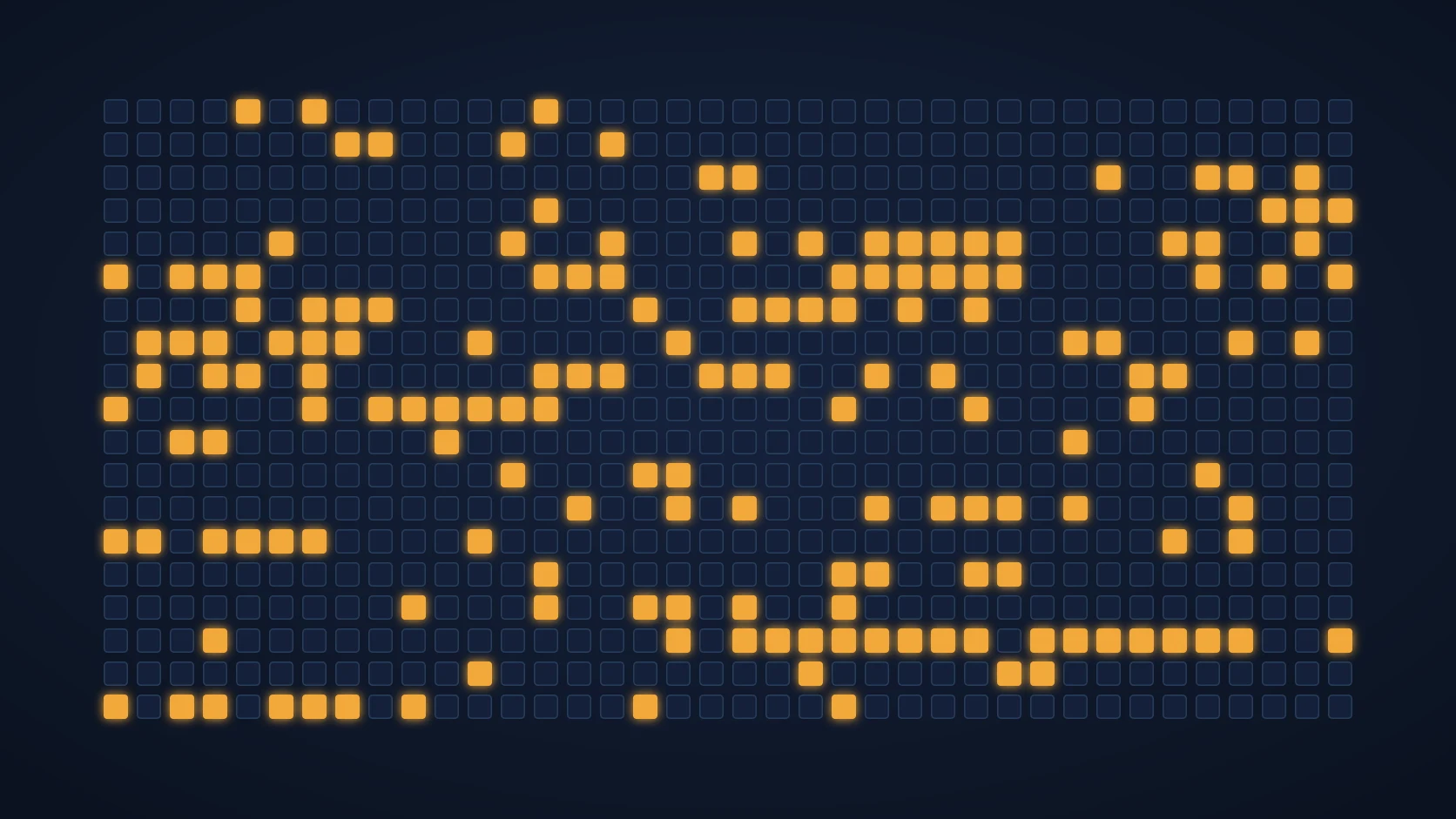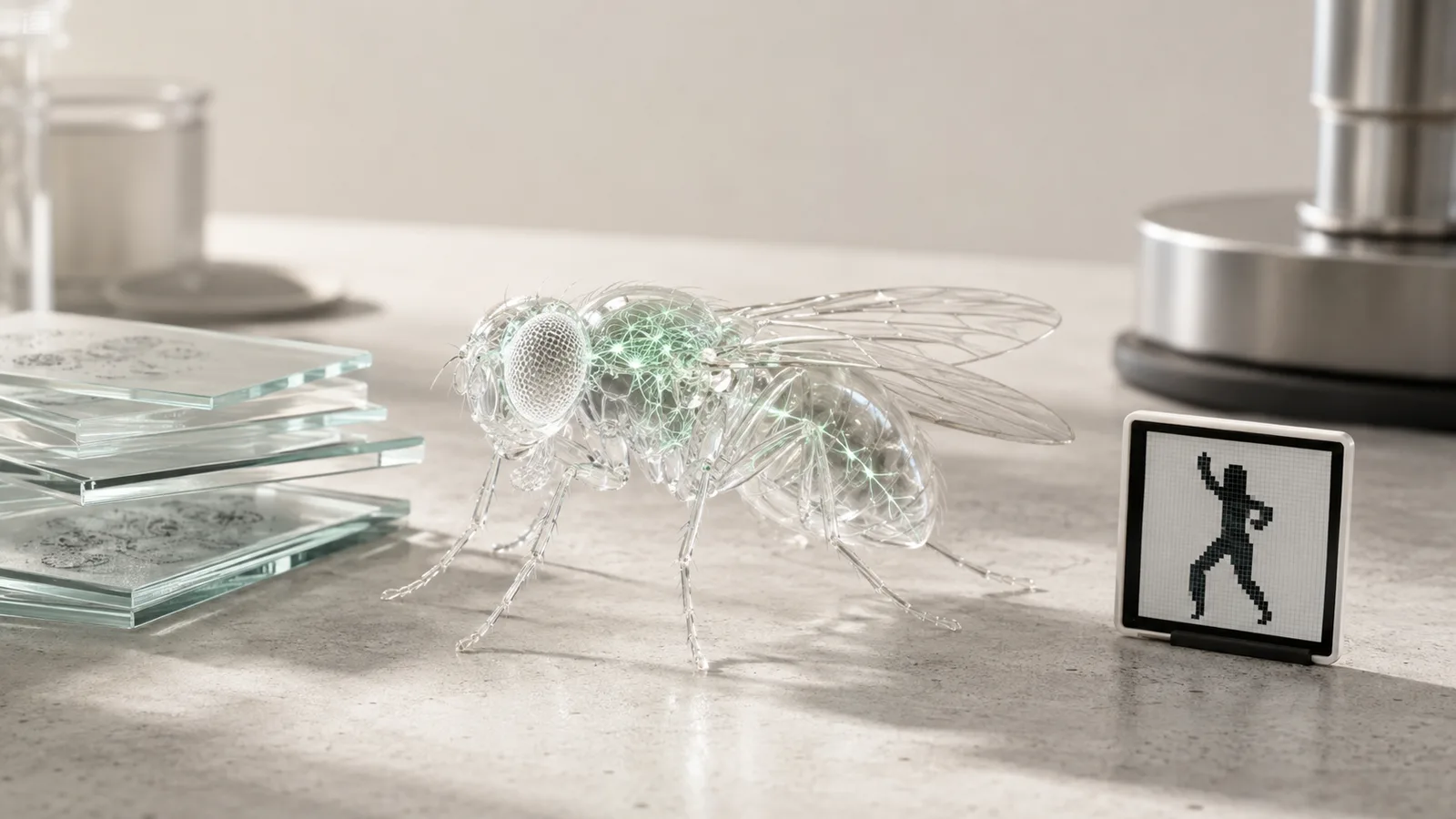
On 6 September 2026, an X user called Kevin (@linguinelabs) posted a nine-second video. On screen, a brain-shaped cloud of dots flickers and, if you look closely, the dots form dancing silhouettes. It is Bad Apple!!, and each dot represents a fly neuron.
The joke has a history. Bad Apple!! is an animation of black silhouettes against a white background that people online have spent years running on increasingly absurd media: calculators, oscilloscopes, Excel spreadsheets. Since it only needs to switch pixels on and off, almost anything can serve as a screen. This time, it was a map of a nervous system.
Three days earlier, on 3 September, Cell had published research on the connectome of a male fly: a reconstruction of its neurons and the connections between them. It includes the brain and the ventral nerve cord, which performs functions comparable to those of our spinal cord. There are 166,700 neurons and around 125 million synapses, the points through which signals are transmitted. By neuron count, it is the largest brain map published as of that date.
Watch the Bad Apple video on the fly brain posted by Kevin · 6 September 2026
Kevin himself described it as “kind of fake”. The video does not demonstrate that there is a fly watching Bad Apple inside a computer. Even so, it is hard to look at those dots without imagining one. That confusion is precisely what makes it funny, and what leaves a question behind: how much would the processes inside have to change before it stopped being just a screen?
A moving fly feels more convincing
The map in the video took much more than downloading a file. Researchers at Janelia, the MRC Laboratory of Molecular Biology, Cambridge and Google combined electron microscopy images, automated reconstruction and human review to trace the neurons and their connections. The review alone amounted to the equivalent of 44 years of one person’s work. They then made the data available to everyone.
On 4 September, before the Bad Apple video, Evan (@evnsnclr) had already posted another video with the map loaded into Minecraft and a fly moving around the game. According to his explanation, it was an early version built with help from a language model, connecting the network’s activity to inputs and actions in the virtual world.
Watch the video of the fly connectome inside Minecraft posted by Evan · 4 September 2026
Here, the feeling that we are looking at an animal grows stronger. There is a body moving through an environment and, behind it, connections taken from a real fly. But the connectome only tells us which neuron connects to which, and how many contacts there are between them. It does not contain everything that determines the system’s activity: the effective strength of each signal, the electrical properties of the cells, the substances that modulate entire circuits, or the changes left by experience. Building a simulation requires decisions about how to fill in what is missing.
The result can be convincing even when those decisions have little to do with the animal. In The digital sphinx, a study presented in March 2026, Bingni Brunton’s and John Tuthill’s groups connected a worm’s map to a virtual fly body through an artificial network trained to control its legs. The chimera walks realistically. The authors describe it as biologically meaningless: the worm’s neurons do not retain their original function, even though the network can produce a good fly gait.
That explains why a video alone leaves so much unresolved. We can recognize a fly in its movements while watching the output of a very different mechanism. With Bad Apple, the gap is even wider: the flashes do not even demonstrate animal behavior. What we see is consistent with an animation painted over the positions of its neurons.
From a map to an animal
There is a more demanding way to use the same material. In 2024, Kristin Scott’s group built a fly brain model from its connections and each neuron’s signal type. They activated the sugar-detecting neurons in it and predicted which others would respond and which were involved in initiating feeding. They then tested those predictions in real flies, using techniques including optogenetics, which allows specific neurons to be activated with light.
The model could anticipate what would happen when researchers intervened in the animal. That correspondence is what the digital sphinx lacks. Another study that year, by Janne Lappalainen and colleagues, took a similar approach to the visual system: it used the connections to build a motion-detecting model and compared its predictions with measurements from real neurons.
These are limited results, but they suggest a possible progression. A model might reproduce more functions and make accurate predictions in situations increasingly unlike those used to build it. We would also need to check how those functions relate: what the animal perceives changes as it moves, what it learns affects its decisions, and its body’s state alters its responses. Getting each part right separately does not guarantee that the whole will work.
The ambition of brain emulation is to reproduce the mechanisms that generate that activity and behavior. The 2025 State of Brain Emulation Report describes the work this requires: recording how the nervous system functions, reconstructing its connections and developing models capable of interacting with a body and an environment. Problems of measurement, modeling and validation remain. We do not know how much detail will be enough.
From the outside, such an emulation might look very much like the fly in the video game. The difference would lie in our reasons for believing that what happens inside corresponds to what happens in the animal. And the stronger those reasons became, the harder it would be to avoid another question: whether reproducing its mechanisms would also have reproduced some form of experience.
When it would stop being a joke
From here on, the discussion is mainly speculative. The work above allows us to reconstruct circuits and predict some of an animal’s responses; it does not demonstrate that we have created conscious experiences in a computer. Both the possibility of doing so and the obligations that would follow remain subjects of debate.
One position that would allow that step is computational functionalism: the idea that consciousness depends on a certain way of processing information, which could be implemented in different substrates. On this hypothesis, reproducing the right organization might be enough to generate experience. Getting the same responses by just any procedure would not suffice: how they are produced would matter. This is the working hypothesis Patrick Butlin, Robert Long and colleagues adopt in their 2023 report on AI consciousness.
Anil Seth questions whether information processing is sufficient. In his defense of biological naturalism, he proposes that consciousness might depend on properties of living organisms that a computer simulation does not reproduce simply by describing them. From this perspective, accurately predicting a brain’s activity might still produce no experience. Seth does not rule out every form of artificial consciousness: he considers its emergence more plausible in systems that more closely resemble brains or living things.
These differences affect what we would count as evidence. Butlin, Long and colleagues propose looking for indicators derived from theories of consciousness: examining whether a system has the mechanisms each theory considers relevant, then adjusting how likely we think it is to be conscious. This is one way to investigate the question, but its results depend on the starting theories. A favorable indicator is not proof, and meeting it does not by itself establish that the system can suffer.
If an emulation ever had pleasant or painful experiences, the moral problem would arise. An invented situation could cause real suffering for whoever experienced it. In The Ethics of Artificial Intelligence, Nick Bostrom and Eliezer Yudkowsky argue that, given equal capacities and conscious experience, changing the substrate should not change moral consideration. The material might matter in explaining whether a system feels; if it did feel, that material would hardly justify counting its suffering for less.
Accepting that criterion would require us to look beyond things that resemble us. An entity would not need to speak or be especially intelligent for making it suffer to require justification. But this is a conditional conclusion: it depends on experiences existing and on accepting that this capacity grounds obligations toward whoever possesses it. We would still need to debate what those obligations are and how to identify the systems to which they would apply.
What we would owe a mind we had created
Almost everything we do with software starts from a simple relationship: we build it for our purposes and decide how to use it. A mind with interests of its own would challenge that relationship. In their defense of the rights of possible artificial intelligences, Eric Schwitzgebel and Mara Garza argue that creating a being with morally human-comparable capacities would not reduce our obligations toward it. It might even give us additional responsibilities. This is an argument about possible beings, not an attribution of those rights to today’s programs.
The extent of that responsibility is also unresolved. An ethics focused on consequences would place particular weight on welfare and harm: what benefit an experiment produces and what suffering it imposes. A rights-based position might also require limits that a favorable balance would not be enough to override. If a mind had desires of its own, memories of its life and the ability to decide, its autonomy or its interest in continuing to exist might matter too. Both concerns appear in Schwitzgebel’s work with Garza on AI design, where they propose taking different moral theories seriously when deciding which systems to create.
For example, faced with a hypothetical mind that refused a task, we could imagine modifying it until it agreed. For a position that protects its autonomy, eliminating the conflict would not demonstrate that we had treated it well: we would have altered the one who refused to suit our purposes. This case takes the discussion beyond pain. It asks what limits there would be on our power over a being whose memories, environment and continued existence might depend entirely on us.
While its capacity to feel remained uncertain, there would be several ways to act. Anders Sandberg proposes a principle of analogy: treating a sufficiently faithful brain emulation with caution comparable to that owed to the original animal. Schwitzgebel and Garza suggest another response through design: avoiding, where possible, creating systems whose claim to human-like moral consideration we cannot determine. One proposal guides how to treat an uncertain model; the other tries to prevent us from reaching that situation.
Neither option is cost-free. In his dilemma about rights for systems of uncertain status, Schwitzgebel identifies the risk of sacrificing human interests for entities that might have no interests of their own, against the risk of gravely harming entities that do. Not every measure needs to be equally demanding: restricting a potentially harmful experiment and granting human-equivalent rights are decisions of different scope. The debate also involves finding which precautions the available evidence would justify.
The ease of copying software would make that discussion more consequential. If each instance could feel, repeating a harmful procedure would multiply the harm. If it could not, we would be counting something nonexistent as suffering. We should therefore assess together the hypothesis’s credibility, the severity of the proposed action and the number of systems involved. Discussing digital welfare does not require treating every program as conscious; it requires explaining when that possibility deserves attention.
Bad Apple does not demonstrate that we are about to create digital subjects, or tell us when that might happen. It offers an entry into a discussion connecting neuroscience, philosophy of mind and ethics. It is worth investigating what conditions might give rise to experiences and debating what we would owe those who had them. Being able to imagine those obligations in considerable detail today does not mean we know whether there will ever be anyone to whom we owe them.
Sources
- Kevin (@linguinelabs): Bad Apple on a fly brain, 2026-09-06.
- Evan (@evnsnclr): MaleCNS v1.0 in Minecraft, 2026-09-04.
- Berg, Beckett, Costa, Schlegel, Takemura, Rubin, Jefferis et al.: Sexual dimorphism in the complete Drosophila male central nervous system connectome, Cell, 2026-09-03.
- MRC Laboratory of Molecular Biology: First complete connectome of male fly central nervous system, 2026-09.
- Google Research: A connectomics milestone, 2026-09-03.
- Brunton, Abe, Hu, Tuthill: The digital sphinx: can a worm brain control a fly body?, bioRxiv, 2026-03.
- Shiu et al. (Kristin Scott): A Drosophila computational brain model reveals sensorimotor processing, Nature, 2024-10.
- Lappalainen et al.: Connectome-constrained networks predict neural activity across the fly visual system, Nature, 2024-09.
- Zanichelli, Schons, Freeman, Shiu, Arkhipov: State of Brain Emulation Report 2025, arXiv, 2025-10.
- Sandberg: Ethics of brain emulations, Journal of Experimental & Theoretical Artificial Intelligence, 2014.
- Butlin, Long et al.: Consciousness in Artificial Intelligence: Insights from the Science of Consciousness, arXiv, 2023-08.
- Seth: Conscious artificial intelligence and biological naturalism, Behavioral and Brain Sciences, accepted manuscript published 2025-04.
- Butlin, Long et al.: Identifying indicators of consciousness in AI systems, Trends in Cognitive Sciences, published online 2025-11.
- Bostrom, Yudkowsky: The Ethics of Artificial Intelligence, manuscript 2011.
- Schwitzgebel, Garza: A Defense of the Rights of Artificial Intelligences, Midwest Studies in Philosophy, 2015.
- Schwitzgebel, Garza: Designing AI with Rights, Consciousness, Self-Respect, and Freedom, manuscript 2018-06.
- Schwitzgebel: The Full Rights Dilemma for A.I. Systems of Debatable Personhood, 2023.